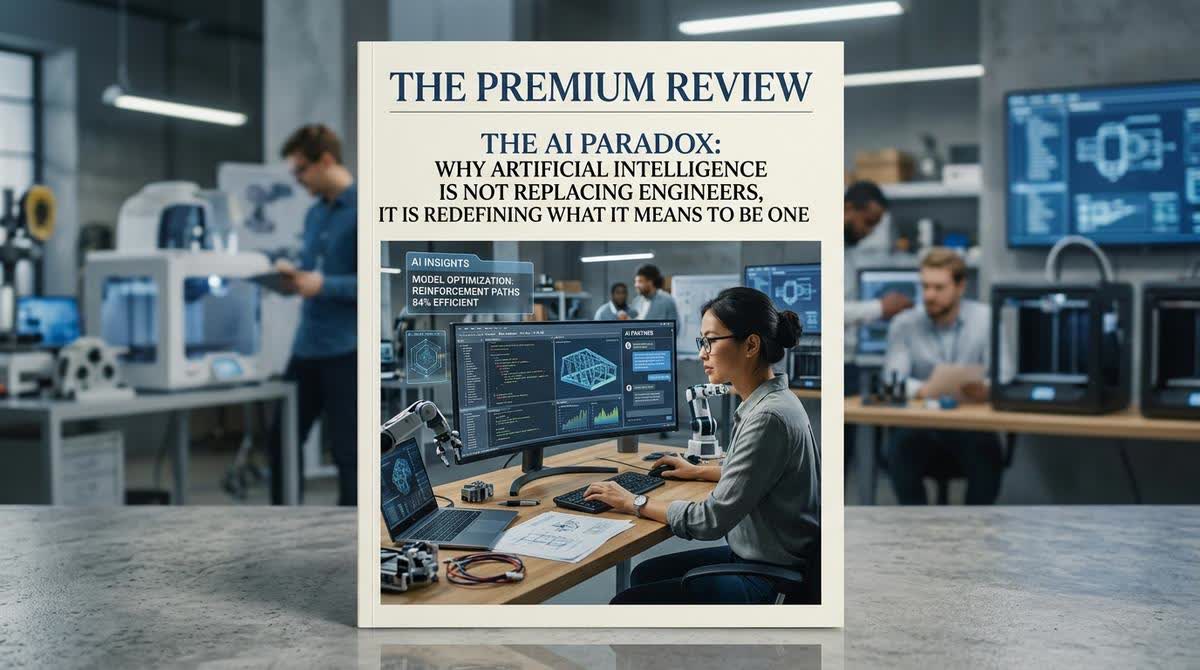
The rise of artificial intelligence has triggered a wave of anxiety across nearly every industry, and the engineering and technical professions are no exception. A quick scan of social media or industry forums reveals a pervasive fear: "AI will write our code." "AI will design our systems." "AI will make our jobs obsolete." This narrative, while dramatic, is a dangerous oversimplification that misses the true nature of both AI and the work of professional engineers.
The reality is far more nuanced and, for those who are willing to adapt, far more optimistic. AI is not a replacement for human expertise; it is a powerful augmentation tool that amplifies human capability. It is a new, sophisticated instrument in the toolbox of the modern engineer. The engineers who will thrive in the coming decade are not those who resist AI, but those who learn to wield it with skill and precision. This article will dismantle the myth of AI replacement and explain why the future belongs to the experts who embrace this new technology as a strategic partner.
The Fundamental Misunderstanding: What AI Actually Does
To understand why AI is not a threat, we must first understand what it actually does. The current generation of AI, often referred to as generative AI (like large language models), is fundamentally a pattern recognition and prediction engine. It does not "think" or "reason" in the human sense. It has no understanding of context, ethics, or the physical world. It is a highly sophisticated statistical model that excels at identifying patterns in vast amounts of data and generating outputs based on those patterns.
What AI Does Well What AI Cannot Do (Yet)
Process massive amounts of data quickly and identify trends. Understand the physical world and the laws of physics.
Generate initial drafts of code, documentation, or designs based on learned patterns. Exercise professional judgment or make ethical decisions.
Suggest solutions based on historical examples. Understand the "why" behind a technical requirement.
Automate repetitive, rule-based tasks to free up human time. Deal with truly novel situations where no historical data exists.
Summarize and synthesize information from multiple sources. Take responsibility for the final outcome.
نصيØØ© الخبير: Ùكر ÙÙŠ الذكاء الاصطناعي باعتباره مساعداً ذكياً للغاية، لكنه مساعد لا يمتلك خبرة عملية ولا ÙŠÙهم سياق المشروع. يمكنه أن يكتب لك عشر نسخ من الكود ÙÙŠ ثوانÙØŒ لكنه لا يعر٠أي نسخة منها ستتعطل ÙÙŠ بيئة التشغيل الÙعلية. هذه المعرÙØ© هي مجال الخبير البشري.
The Cost of AI: Why "Free" Is Not Really Free
One of the most seductive promises of AI is that it is free and accessible to everyone. While it is true that basic versions of many AI tools are available at little or no cost, the reality for professional use is significantly different. Using AI effectively in a professional context carries hidden costs that make it inaccessible to casual users and a strategic investment for serious organizations.
The True Costs of Professional AI Use:
Cost Type Description Why It Matters
Data and Training Costs Enterprise-grade AI models require training on specific, proprietary data to be useful. Training a custom model for a specific use case (e.g., reading electrical schematics) requires significant investment in data preparation, annotation, and computing power.
Integration Costs AI tools must be integrated into existing workflows and systems, which takes time and specialized skills. A company cannot simply "add AI" to its workflow. The integration process can be complex and costly.
Expertise and Oversight Costs AI outputs must be reviewed, validated, and corrected by subject matter experts. This is the most significant hidden cost. A junior engineer cannot simply trust AI-generated code or designs. Every output must be audited by a senior professional. This takes time and costs money.
Infrastructure and Licensing Costs Enterprise-grade AI tools require significant computing infrastructure and expensive licenses. These costs can be substantial, especially for organizations that need high availability and security.
Maintenance and Evolution Costs AI models degrade over time and must be retrained and updated. The work is never "done" with AI. It requires continuous investment to remain effective.
The Real-World Implication: The "free" AI tools available to the public are not suitable for professional, mission-critical work. They lack the specificity, accuracy, and reliability required. Professional AI deployment requires a significant investment of capital, time, and expertise. This means that the organizations and individuals who can afford to invest in AI are the ones who will benefit from it, widening the gap between the casual user and the professional expert.
نصيØØ© الخبير: إذا كنت تستخدم ChatGPT أو أي أداة AI مجانية لمشاريعك الهندسية، Ùأنت تخاطر. هذه الأدوات ليست مصممة للدقة المطلوبة ÙÙŠ مجالنا، وهي لا تتØمل أي مسؤولية عن الأخطاء التي ترتكبها. الخبراء الØقيقيون يستثمرون ÙÙŠ أدوات مدÙوعة ومخصصة، ويخصصون موارد كبيرة للتØقق من مخرجاتها.
How AI Is Actually Transforming the Engineering Profession
The transformation AI is bringing is not replacement, it is augmentation. It changes what engineers do, not whether engineers are needed.
1. The Shift from Creator to Curator
In the past, an engineer's primary value was in creating solutions from scratch. With AI, much of the initial creation can be automated. The engineer's role shifts from "creator" to "curator." The value now lies in:
Defining the Right Problem: AI cannot tell you what problem to solve. That requires human understanding of business needs and operational context.
Selecting the Right Prompt: The quality of AI output depends entirely on the quality of the input. Crafting effective prompts is a skill that requires deep domain knowledge.
Validating and Refining the Output: The engineer must critically evaluate the AI's suggestions, identify errors, and refine the output to meet professional standards.
Integrating and Deploying the Solution: The final product must be integrated into a larger system and deployed into the real world. This is a deeply human task that requires judgment and experience.
2. The Acceleration of the "Routine" Work
AI excels at automating routine, repetitive tasks. This frees up engineers to focus on higher-value activities.
Routine Tasks That Can Be Automated Higher-Value Tasks That Are Now Possible
Writing boilerplate code for a new module. Designing the overall system architecture.
Generating initial drafts of technical documentation. Analyzing the system's performance and optimizing it.
Performing standard calculations (e.g., cable sizing). Evaluating the business impact of technical decisions.
Searching for a known error in a code base. Mentoring junior engineers and building team capability.
Creating initial drafts of proposals and reports. Building client relationships and understanding their needs.
3. The Democratization of Knowledge
AI makes vast amounts of technical knowledge accessible to a much wider audience. A junior engineer can now get instant answers to questions that would have required hours of research in the past. This is not a threat; it is an acceleration of the learning curve.
The Danger: The ease of access can create a false sense of competence. Getting an answer from AI is not the same as understanding the underlying principles. This is where the expert's role becomes even more critical.
نصيØØ© الخبير: الذكاء الاصطناعي يمكن أن يعطيك الإجابة، لكنه لا يعطيك الÙهم. وأنت ÙÙŠ مجالنا، الÙهم هو الذي يمنع الكوارث. الخبراء الØقيقيون لا يستخدمون الذكاء الاصطناعي للتÙكير نيابة عنهم، بل يستخدمونه لتوسيع قدرتهم على التÙكير ÙˆØÙ„ المشاكل المعقدة بشكل أسرع.
The New Role of the Expert: The AI Strategist
The rise of AI is not the end of the expert; it is the birth of a new kind of expert. The future belongs to the "AI Strategist" – the professional who understands both the technology and its strategic application.
The Old Engineer (Pre-AI) The AI Strategist (The Future)
Spends 70% of time on routine, repetitive tasks. Spends 30% of time on routine tasks, using AI to automate them.
Creates solutions from scratch, often with trial and error. Guides AI to generate multiple solutions and uses their expertise to select the best one.
Writes all the code themselves. Writes 30% of the code and uses AI to generate the remaining 70% based on their detailed specifications.
Focuses on "doing the work." Focuses on "defining the work" and "quality assuring the work."
Reacts to problems as they arise. Uses AI to predict and prevent problems before they occur.
Practical Applications of AI in the ELV and Technology Sector
The applications of AI in our field are already extensive and growing rapidly.
1. Design and Engineering:
Automated Cable Sizing: AI can analyze loads, distances, and environmental factors to recommend the optimal cable size and type.
Network Design Optimization: AI can analyze network requirements and propose optimal switch, router, and access point placement for maximum coverage and performance.
Code Review: AI tools can scan thousands of lines of code for security vulnerabilities, bugs, and performance issues faster than any human team.
AI-Assisted Drafting: AI can generate initial drafts of system diagrams and schematics based on textual descriptions.
2. Site Operations and Maintenance:
Predictive Maintenance: AI analyzes sensor data from equipment (vibration, temperature, power consumption) to predict failures before they occur.
Anomaly Detection: AI can identify unusual patterns in building system data that indicate a developing problem, such as a chiller starting to lose efficiency.
Automated Troubleshooting: AI can analyze error logs and system data to suggest the most likely cause of a fault.
3. Software Development:
AI-Assisted Coding: Tools like GitHub Copilot can generate code based on comments and existing code, dramatically speeding up development.
Automated Testing: AI can generate and run thousands of test cases to ensure software quality.
Bug Fixing: AI can analyze error logs and suggest the most effective fix for a specific bug.
4. Business and Operations:
Proposal Generation: AI can generate initial drafts of technical proposals based on project requirements.
Cost Estimation: AI can analyze historical project data to provide more accurate cost estimates.
Automated Reporting: AI can generate reports, presentations, and dashboards from raw data.
The Final Lesson: The Future Belongs to the Experts Who Adapt
The rise of AI is not a threat to the engineering profession; it is a call to evolve. The engineers, developers, and technical professionals who will thrive in the coming decade are not those who resist AI, but those who embrace it as a powerful tool for augmentation. They will invest the time to learn how to use it effectively and will focus their energy on the higher-value, strategic work that AI cannot do.
At AllandMuchMore, we are committed to being at the forefront of this evolution. Our teams are trained to use AI tools effectively, not to replace their expertise, but to enhance it. We invest in the infrastructure and training required to use AI professionally, and we understand that the true value of AI comes not from the technology itself, but from the skilled professionals who wield it. This is the future of our industry, and we are ready for it.