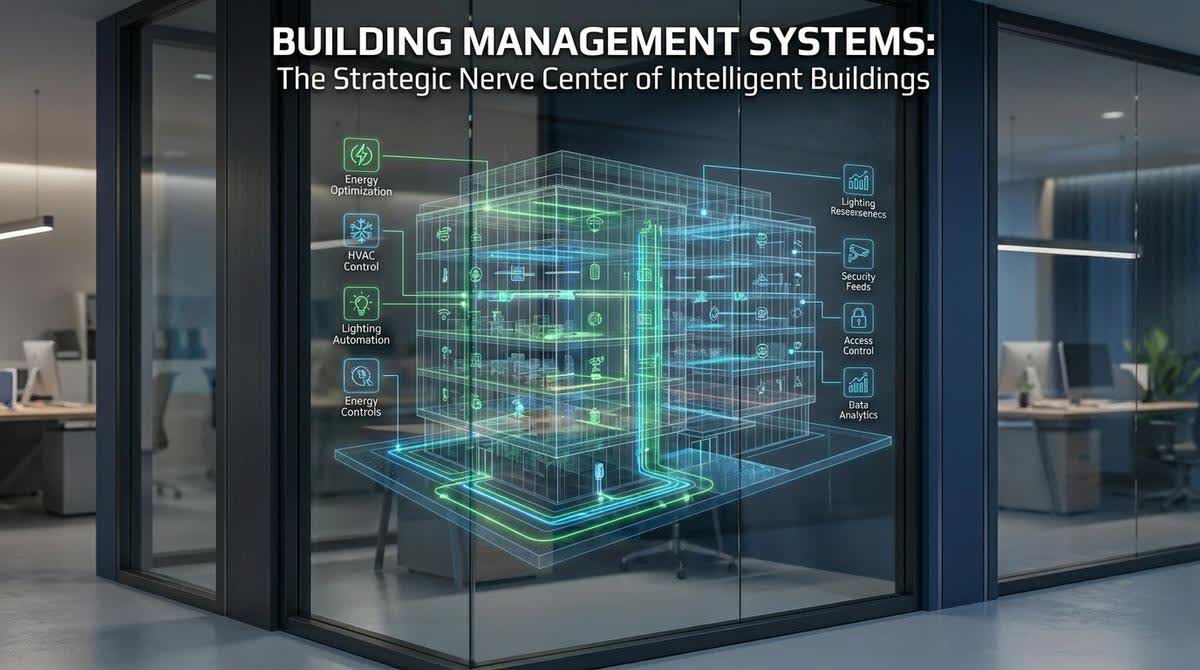
Building Management Systems: The Strategic Nerve Center of Intelligent Buildings
Building Management Systems have undergone a remarkable transformation over the past two decades.
What once were simple programmable controllers managing heating and cooling cycles have evolved into sophisticated intelligence platforms that touch virtually every aspect of building operations.
This evolution reflects a fundamental shift in how we view buildings themselves, not as static structures but as dynamic, responsive environments that can learn, adapt, and optimize.
The strategic importance of BMS in modern buildings cannot be overstated.
It is the system that connects and coordinates all other building systems, creating value far beyond the sum of its parts.
When properly designed and implemented, a BMS becomes the nerve center of the intelligent building, enabling operational excellence, energy efficiency, occupant satisfaction, and sustainability.
The Strategic Value Proposition
Building owners and investors are increasingly recognizing that BMS is not an expense but an investment that delivers measurable returns across multiple dimensions of building performance.
Operational Excellence
The BMS provides building operators with unprecedented visibility into system performance.
Instead of reacting to problems after they occur, operators can identify issues before they impact building performance.
Fault detection and diagnostics capabilities alert operators to developing problems, enabling proactive maintenance that prevents failures and extends equipment life.
The result is significantly reduced downtime, lower maintenance costs, and more predictable building operations.
Energy Optimization
Energy costs typically represent thirty to forty percent of building operating expenses.
The BMS provides the tools to optimize energy consumption systematically.
By analyzing usage patterns, occupancy data, and weather conditions, the BMS can adjust HVAC operation, lighting levels, and other systems to minimize energy waste while maintaining comfort.
Organizations typically achieve energy savings of fifteen to thirty percent through proper BMS implementation, savings that directly impact the bottom line.
Occupant Comfort and Productivity
The relationship between building environment and occupant productivity is well documented.
Comfortable temperatures, good air quality, and appropriate lighting directly impact employee performance.
The BMS ensures that building systems operate to maintain optimal conditions.
When occupants can control their environment within appropriate parameters, satisfaction improves.
The business case is compelling, even modest improvements in productivity can yield returns that far exceed the cost of BMS investment.
Sustainability and ESG Performance
Investors, tenants, and regulators are increasingly focused on environmental performance.
The BMS provides the data and control needed to demonstrate sustainability achievement.
Energy consumption tracking, emissions reporting, and green building certification support all rely on BMS capabilities.
Organizations that can demonstrate strong environmental performance command premium rents and valuations.
Understanding BMS Architecture
The BMS architecture follows a three-tier model that has proven effective across all building types and sizes.
Understanding this architecture is essential for making informed investment decisions.
The Field Level
At the lowest tier are the field devices that sense and control building conditions.
Temperature sensors, humidity sensors, pressure transducers, and occupancy detectors provide the data that drives decision making. Actuators and controllers execute commands from higher-level systems.
This tier represents the physical interface between the BMS and the building itself.
The Control Level
The middle tier consists of Direct Digital Controllers (DDCs) that process data from field devices and execute control strategies.
These intelligent controllers can operate independently if communication with higher-level systems is lost.
They implement control logic for specific building systems, making decisions based on programmed parameters and sensor inputs.
The Management Level
The top tier provides the human interface and advanced capabilities.
BMS servers, management software, operator workstations, and databases comprise this tier.
Operators monitor building performance, adjust settings, and generate reports through this interface.
Advanced analytics and reporting capabilities are also delivered at this tier.
The Integration Imperative
A BMS is only as effective as its ability to integrate with other building systems.
Isolated systems cannot deliver the comprehensive intelligence that modern buildings require.
HVAC Integration
HVAC systems are the primary focus of traditional BMS.
Integration enables sophisticated strategies like demand control ventilation, optimal start/stop, and economizer operation.
The BMS coordinates chillers, boilers, air handlers, and terminal units to deliver comfort efficiently.
Lighting Control Integration
Lighting represents a significant portion of building energy consumption.
BMS integration with lighting control enables strategies like daylight harvesting, occupancy-based lighting, and scheduling. Coordinated lighting and HVAC control amplifies energy savings.
Access Control Integration
Access control provides the BMS with valuable occupancy data.
When integrated, the BMS knows which areas are occupied and can adjust HVAC and lighting accordingly.
This reduces energy waste in unoccupied spaces while ensuring comfort when spaces are occupied.
Fire Alarm Integration
Fire alarm integration is essential for life safety.
The BMS responds to fire detection by shutting down HVAC systems, closing smoke dampers, and supporting evacuation.
This integration is required by code and must be reliable.
Power Monitoring Integration
Power monitoring provides visibility into energy consumption and power quality.
The BMS can use this data to optimize system operation and identify opportunities for improvement.
Integration enables comprehensive energy management.
The Business Case for BMS Investment
Building owners and investors need a clear understanding of the financial case for BMS investment.
The returns are compelling across multiple dimensions.
Energy Savings
Energy savings represent the most quantifiable benefit of BMS investment.
Organizations typically achieve fifteen to thirty percent reduction in energy consumption.
For a 500,000 square meter office building with annual energy costs of 800,000 dollars, this represents annual savings of 120,000 to 240,000 dollars.
Maintenance Cost Reduction
The BMS enables predictive and condition-based maintenance that reduces maintenance costs.
Instead of following fixed schedules, maintenance can be performed when needed.
This typically reduces maintenance costs by ten to twenty-five percent while improving equipment reliability.
Equipment Life Extension
Proper operation extends equipment life.
The BMS ensures that equipment operates within design parameters, avoiding conditions that cause premature failure.
Equipment life extension of ten to fifteen percent is typical.
Operational Efficiency
Building operators can manage more facilities effectively with BMS support.
Remote monitoring reduces the need for on-site presence.
Automated reporting eliminates manual data collection.
Operational efficiency improvements of fifteen to twenty-five percent are achievable.
Tenant Retention and Attraction
Buildings with modern, well-performing BMS command higher rents and attract better tenants.
Occupants value comfortable, efficient, and sustainable buildings.
The BMS supports the premium positioning that drives higher returns.
Implementation Considerations
Successful BMS implementation requires careful attention to several critical factors.
System Selection
Choosing the right BMS platform is essential.
Consider scalability, open protocol support, integration capabilities, and vendor reputation.
The platform must support current requirements and accommodate future needs.
Design Quality
The BMS design must reflect a thorough understanding of building systems and operational requirements.
Control strategies must be appropriate for the building and its use.
Points must be selected to provide necessary visibility and control.
Installation Quality
Quality installation is essential for reliable operation.
Proper termination, labeling, and documentation prevent problems and facilitate maintenance.
Experienced installation teams with BMS expertise are required.
Commissioning Thoroughness
Commissioning verifies that the BMS performs as designed.
Every point must be tested, every control sequence verified, and every integration function confirmed.
Thorough commissioning prevents operational problems and ensures that the BMS delivers expected benefits.
Training Investment
The BMS is only as effective as the people who operate it.
Comprehensive operator training is essential.
Operators must understand system capabilities, control strategies, and troubleshooting procedures.
Ongoing training supports continuous improvement.
Future Trends in BMS
The BMS continues to evolve rapidly, incorporating advances in technology and addressing new requirements.
Predictive Analytics
Machine learning and artificial intelligence are enabling predictive capabilities.
The BMS can now predict equipment failures before they occur, optimize strategies based on historical performance, and continuously improve operation.
Cloud-Based Management
Cloud platforms enable centralized management of multiple buildings.
Facility managers can monitor and control buildings from anywhere.
Cloud-based solutions reduce on-site infrastructure requirements and simplify system updates.
IoT Integration
The Internet of Things is expanding the scope of BMS capabilities.
New sensors provide additional data points. IoT devices can be integrated into the BMS ecosystem.
The BMS becomes the platform for comprehensive building intelligence.
Digital Twins
Digital twin technology creates virtual representations of buildings.
These models enable simulation, optimization, and training without impacting actual operations.
Digital twins represent the future of building management.
Sustainability Focus
Sustainability requirements continue to drive BMS evolution.
Carbon tracking, emissions reporting, and green building certification support are increasingly important capabilities.
The BMS must support comprehensive sustainability management.
The AllandMuchMore Perspective
At AllandMuchMore, we understand that BMS is a strategic investment that requires comprehensive expertise.
Our approach reflects this understanding.
Strategic Assessment
We begin by understanding your business objectives and operational requirements.
We assess current performance and identify opportunities for improvement. Our recommendations are grounded in business case analysis.
Comprehensive Design
We design BMS solutions that address your specific requirements.
Our designs reflect deep technical expertise and practical experience. We consider integration requirements, future needs, and operator requirements.
Quality Implementation
Our experienced teams deliver quality installation and thorough commissioning.
We ensure that every system function performs as designed. Our documentation is complete and comprehensive.
Operational Support
We provide comprehensive training and ongoing support.
We help you optimize system performance over time.
Our relationship extends beyond installation.
In the End :
Building Management Systems have become essential for modern buildings.
They deliver operational excellence, energy efficiency, occupant satisfaction, and sustainability.
The strategic value extends far beyond technical capability.
Organizations that invest in quality BMS implementation gain competitive advantage.
They operate more efficiently, attract better tenants, and demonstrate environmental leadership.
The BMS is not just a building system, it is a strategic asset.
At AllandMuchMore, we have the expertise to help you realize the full value of BMS investment.
Our comprehensive approach covers everything from strategic planning through operational optimization.
When you work with us, you are investing in building intelligence that delivers measurable returns.