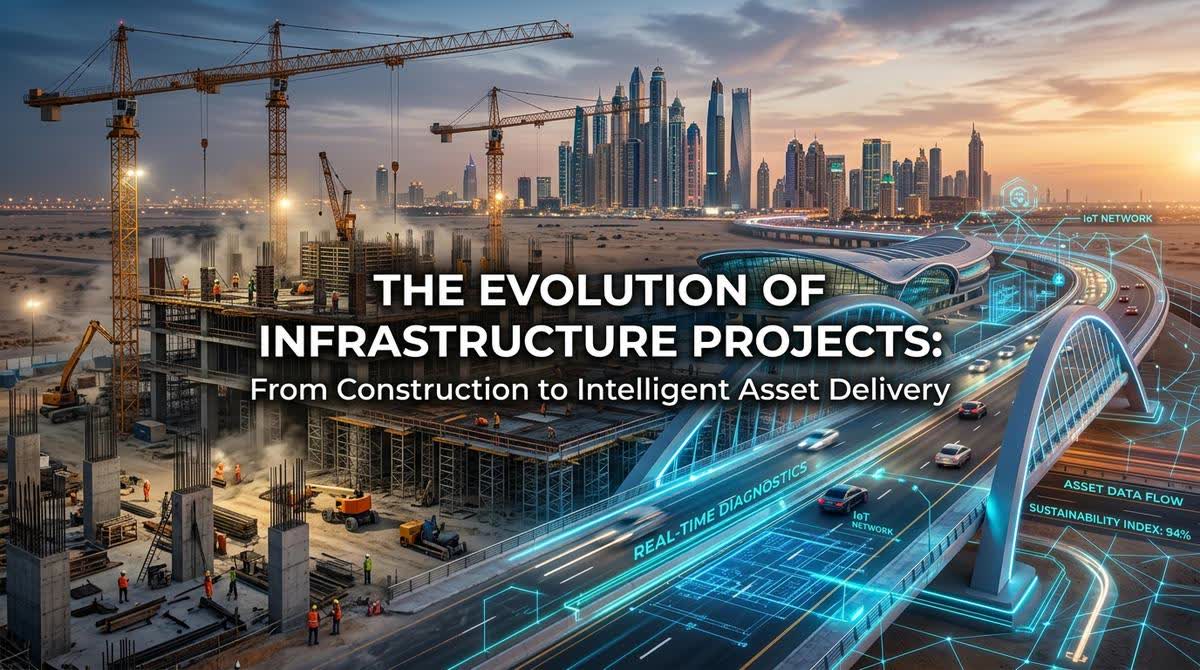
The Evolution of Infrastructure Projects: From Construction to Intelligent Asset Delivery
The infrastructure sector is experiencing a transformation as profound as any in its history, driven by the convergence of digital technology, changing stakeholder expectations, and the imperative for greater efficiency and sustainability. Projects that were once focused primarily on construction are increasingly understood as the delivery of intelligent assets that will create value throughout their operational lifecycle. This shift has fundamental implications for how projects are planned, delivered, and operated.
For owners, developers, and investors across the Middle East, understanding this evolution is essential for competitive positioning and long-term value creation. The region has embraced infrastructure development with remarkable ambition, and those who adapt to the changing nature of project delivery will capture significant advantage over those who remain focused on traditional approaches.
The Changing Nature of Infrastructure Assets
The assets that infrastructure projects deliver are fundamentally different from those of a generation ago, reflecting the integration of technology into every aspect of the built environment.
From Passive to Intelligent
Traditional infrastructure assets were essentially passive structures that provided shelter or supported basic functions. Today's assets are intelligent systems that sense, respond, and adapt to their environment and users. Buildings communicate with occupants and optimize their operation automatically. Transportation infrastructure manages traffic flow and predicts maintenance needs. The intelligence is embedded in the asset from the beginning.
From Static to Dynamic
Traditional assets were static structures that changed little over their operational life. Today's assets are dynamic systems that evolve and improve over time. Software updates provide new capabilities. Data analytics inform operational optimization. The asset learns and improves through experience. This dynamic nature changes the relationship between asset delivery and asset operation.
From Siloed to Integrated
Traditional assets were designed and operated as isolated systems. Today's assets are integrated components of larger ecosystems. Buildings connect to smart city infrastructure. Transportation systems integrate with mobility services. The value of the asset depends on its integration with its environment. This integration must be considered from the earliest stages of project planning.
From Cost to Value Focus
Traditional project delivery focused primarily on cost and schedule. Today's approach considers the full lifecycle value of the asset. Operating costs, revenue potential, and risk exposure are all considered in investment decisions. The focus has shifted from minimizing initial cost to maximizing long-term value.
The Drivers of Transformation
Several factors are driving the transformation of infrastructure project delivery.
Technological Advancement
The rapid advancement of digital technology has made intelligent infrastructure feasible and cost-effective. Sensors are inexpensive and capable. Connectivity is ubiquitous. Analytics are sophisticated and accessible. The technology exists to create intelligent assets.
Stakeholder Expectations
Stakeholders increasingly expect intelligent infrastructure. Occupants expect connected, responsive environments. Regulators expect sustainability and resilience. Investors expect data-driven asset management. Meeting stakeholder expectations drives technology adoption.
Competitive Dynamics
Competition in the infrastructure sector is intensifying. Projects are larger and more complex. Margins are under pressure. Differentiation through technology and intelligence is increasingly important. Competitive dynamics drive innovation.
Sustainability Imperatives
Sustainability requirements are increasing and becoming more urgent. Buildings and infrastructure must reduce energy consumption and emissions. Intelligence enables sustainability achievement. The sustainability imperative drives technology adoption.
Economic Factors
Economic factors support intelligent infrastructure investment. Operating cost savings from intelligent systems can be substantial. Revenue opportunities from data and services are emerging. The economic case for intelligent infrastructure is compelling.
The Impact on Project Delivery
The transformation to intelligent asset delivery affects every phase of the project lifecycle.
Planning and Feasibility
Project planning must now consider technology requirements and lifecycle value. Feasibility studies must evaluate technology investment and returns. Stakeholder requirements for intelligence must be understood. Planning must address integration with broader systems. The planning phase sets the foundation for intelligent asset delivery.
Design and Engineering
Design must incorporate technology infrastructure and intelligent systems. Systems integration must be designed from the beginning, not added later. Technology requirements must inform design decisions. Design must support future evolution and capability expansion. The design phase determines the intelligence potential of the asset.
Procurement and Contracting
Procurement must address technology requirements and integration. Contracts must specify performance requirements for intelligent systems. Technology vendors must be engaged appropriately. Integration responsibilities must be clearly defined. Procurement must support intelligent asset delivery.
Construction and Installation
Construction must accommodate technology infrastructure installation. Coordination between trades is essential for technology integration. Installation must follow best practices for intelligent systems. Quality assurance must address technology performance. Construction must deliver the foundation for intelligence.
Commissioning and Handover
Commissioning must verify intelligent system performance. Integration testing must confirm system interaction. Documentation must support future operation and evolution. Training must prepare operators for intelligent system management. Handover must transition a fully functional intelligent asset.
Operation and Lifecycle Management
Operation must leverage intelligent system capabilities. Data must be used for continuous improvement. Systems must be maintained and updated. Evolution must be planned and executed. The operational phase realizes the value of intelligent asset investment.
Strategic Considerations for Project Owners
Project owners must adapt their approach to succeed in the era of intelligent asset delivery.
Lifecycle Perspective
Project owners must adopt a lifecycle perspective that extends beyond construction completion. Technology investment must be evaluated over the full operational life of the asset. Operating costs, revenue opportunities, and risk exposure must all be considered. The lifecycle perspective guides investment decisions.
Technology Investment Strategy
Technology investment must be strategic rather than reactive. Owners must identify technology priorities based on their objectives. Investment should focus on technologies that deliver the greatest value. Technology strategy should consider future evolution.
Partner Selection
Partners must be selected based on their ability to support intelligent asset delivery. Contractors must demonstrate technology capability. Technology vendors must support integration and evolution. Partners must share the lifecycle perspective. Partner selection is critical for success.
Data Strategy
Data is a valuable asset that must be managed strategically. Owners must determine how data will be collected, stored, analyzed, and used. Data ownership and access rights must be addressed in contracts. Data strategy should consider opportunities for monetization. Data strategy is increasingly important for asset value.
Risk Management
Intelligent assets introduce new risks that must be managed. Cybersecurity risks must be addressed. Technology obsolescence must be planned for. Integration risks must be managed. Risk management must address the full spectrum of risks.
The Role of ELV Systems in Intelligent Asset Delivery
ELV systems are the foundation of intelligent asset delivery, enabling the capabilities that define modern infrastructure.
Communications Infrastructure
Communications infrastructure is the nervous system of intelligent assets. Structured cabling, wireless networks, and fiber optics enable connectivity and data transmission. The quality of communications infrastructure determines the capabilities of intelligent systems.
Building Management Systems
BMS are the central intelligence of modern buildings. They coordinate and optimize building systems for efficiency, comfort, and performance. BMS enable the intelligence that defines modern buildings.
Security Systems
Security systems protect assets and occupants. CCTV, access control, and intrusion detection systems provide comprehensive security capabilities. Security systems are essential components of intelligent assets.
Sustainability Systems
Sustainability systems enable environmental performance. Energy monitoring, lighting control, and HVAC optimization reduce consumption and emissions. Sustainability systems deliver both environmental and economic benefits.
Integration Systems
Integration systems connect ELV systems to each other and to external platforms. Integration enables comprehensive intelligence that exceeds the capability of individual systems. Integration systems are essential for intelligent asset delivery.
Implementation Considerations for the Middle East
The Middle East presents unique opportunities and challenges for intelligent asset delivery.
Project Scale and Complexity
Projects in the region are often large and complex, requiring sophisticated technology solutions. The scale of projects provides opportunities for technology innovation. The complexity demands comprehensive system integration. Technology solutions must be scaled appropriately.
Climate Considerations
The extreme climate of the region places demands on building systems and technology. Cooling and energy management are critical. Technology must be robust and reliable in challenging conditions. Climate considerations must inform technology selection and design.
Regulatory Environment
Regulatory requirements for technology and sustainability are evolving rapidly. Understanding and anticipating regulatory evolution is essential. Compliance must be built into project planning. Regulatory awareness supports strategic decision-making.
Market Sophistication
The Middle East market is sophisticated and demanding. Stakeholders expect high-quality technology solutions. Competition rewards innovation and quality. Meeting market expectations requires excellence in intelligent asset delivery.
International Standards
The region operates to international standards and best practices. Technology solutions must meet international quality standards. Integration with global systems and platforms is often required. International standards provide a benchmark for quality.
The AllandMuchMore Perspective
At AllandMuchMore, we understand the transformation of infrastructure project delivery and its implications for our clients. Our approach reflects this understanding.
Strategic Advisory
We provide strategic advisory services to help clients navigate the evolution to intelligent asset delivery. Our advice is grounded in deep understanding of technology, markets, and project delivery. We help clients make informed investment decisions.
Integrated Solutions
We provide integrated solutions that deliver intelligent assets. Our solutions combine technology expertise with project delivery capability. We manage the complexity of intelligent system integration. Our solutions deliver the full value of intelligent assets.
Quality Delivery
We deliver quality projects that meet client requirements and expectations. Our experienced teams follow best practices for installation and integration. Our quality assurance processes verify system performance. We deliver assets that perform as designed.
Lifecycle Support
We support clients throughout the asset lifecycle. Our services extend from planning through operations. We help clients optimize asset performance and evolve capability over time. Our lifecycle support protects client investment.
In the End :
The infrastructure sector is undergoing a fundamental transformation from construction to intelligent asset delivery. Projects are increasingly understood as the delivery of intelligent assets that will create value throughout their operational lifecycle. This transformation has profound implications for how projects are planned, delivered, and operated.
Project owners, developers, and investors who embrace this transformation gain competitive advantage. They deliver assets that meet evolving stakeholder expectations, operate efficiently, and create long-term value. Those who remain focused on traditional approaches risk obsolescence and value erosion.
At AllandMuchMore, we have the expertise to help you navigate the transformation to intelligent asset delivery. Our comprehensive approach covers everything from strategic planning through lifecycle support. When you work with us, you are investing in the future of infrastructure.