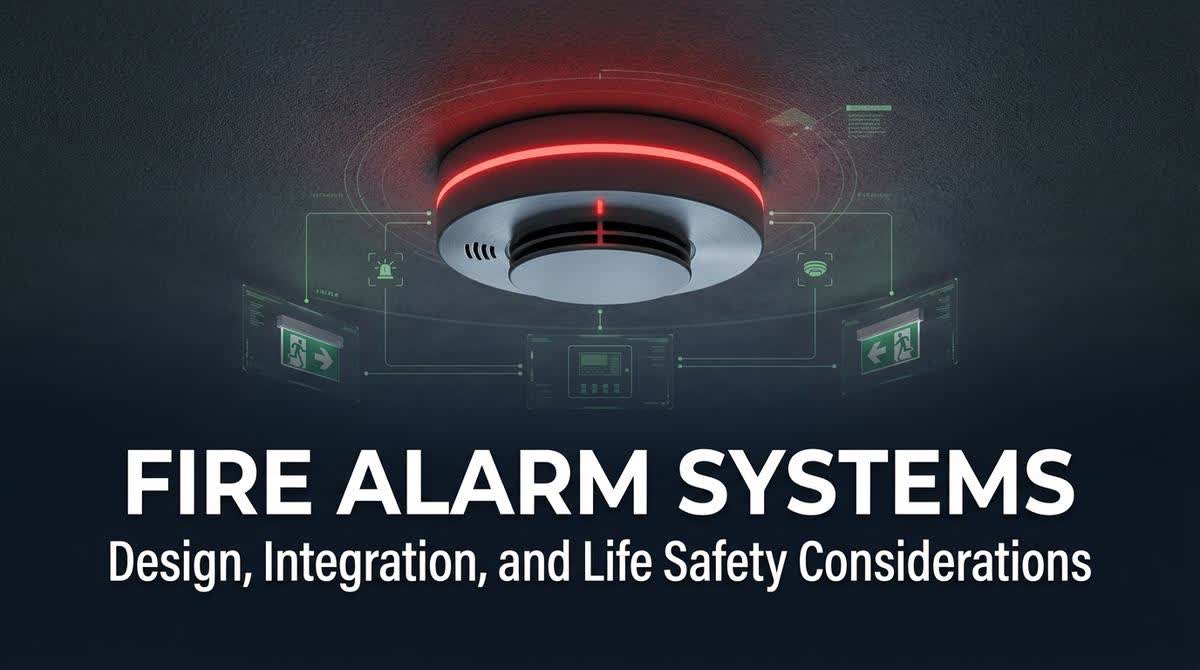
Fire Alarm Systems: Design, Integration, and Life Safety Considerations
Fire alarm systems are the most critical life safety systems in any building.
Their purpose is simple, to protect lives and property by detecting fires early and warning occupants.
The implementation, however, is complex and requires deep understanding of codes, standards, and practical considerations.
This guide provides comprehensive coverage of modern fire alarm system design, installation, and integration.
It addresses the technical and strategic considerations that ensure effective life safety protection.
The Strategic Importance of Fire Alarm Systems
Fire alarm systems are not optional or discretionary.
They are mandatory life safety systems required by building codes worldwide.
The consequences of failure are potentially catastrophic.
Life Safety
Protecting human life is the primary purpose of fire alarm systems.
Early detection provides critical time for evacuation.
Reliable operation saves lives.
Property Protection
Fire alarm systems minimize property damage by enabling rapid response.
Early detection allows fire services to respond before the fire spreads.
Property protection reduces financial losses and business interruption.
Code Compliance
Fire alarm systems must comply with applicable building codes and standards.
Compliance is not optional and is required for building occupancy.
Authorities having jurisdiction enforce compliance.
Legal and Financial Protection
Non-compliant or poorly designed systems expose building owners to liability.
Insurance coverage often requires compliant and properly maintained systems.
Properly designed systems reduce legal and financial risk.
Understanding Fire Alarm System Types
Conventional Systems
Conventional systems group detectors and devices into zones.
Each zone corresponds to a specific area or floor.
When a device activates, the panel indicates which zone is affected.
Advantages
Simple design and installation.
Cost-effective for smaller buildings.
Easy to maintain and repair.
Disadvantages
Limited ability to identify specific device locations.
More difficult to troubleshoot.
Less flexible for building changes.
Applications
Smaller buildings with limited zones.
Buildings with simple layouts and low complexity.
Budget-constrained projects.
Addressable Systems
Addressable systems assign a unique address to each device.
The control panel can identify exactly which device has activated.
This provides much more information about the incident.
Advantages
Precise identification of device location.
Faster response and troubleshooting.
More flexible and easier to modify.
Better information for emergency response.
Disadvantages
Higher initial cost.
More complex design and installation.
Requires trained technicians for maintenance.
Applications
All modern buildings with life safety requirements.
Buildings requiring precise identification for rapid response.
Complex buildings where flexibility is important.
Networked Systems
Networked systems connect multiple control panels in a single network.
This provides coordinated protection for large or multi-building facilities.
The system can be monitored and controlled from a central location.
Advantages
Coordinated response across large facilities.
Centralized monitoring and control.
Redundant communication paths.
Scalable for campus environments.
Disadvantages
Higher complexity and cost.
Requires network infrastructure.
More complex commissioning and testing.
Applications
Large buildings and campuses.
Multibuilding facilities.
Complex facilities requiring centralized management.
System Components and Operation
Detection Devices
Smoke Detectors
Smoke detectors respond to the presence of smoke particles.
They are the most common type of fire detector.
Smoke detectors provide early warning before heat and flames are present.
Photoelectric Smoke Detectors
Photoelectric detectors use a light beam and sensor to detect smoke.
They are more responsive to smoldering fires.
Photoelectric detectors are less prone to nuisance alarms than ionization detectors.
Ionization Smoke Detectors
Ionization detectors use a small radioactive source to detect smoke.
They are more responsive to flaming fires.
Ionization detectors are being phased out in many applications.
Smoke Beam Detectors
Smoke beam detectors project a beam of light across a large open area.
They detect smoke by monitoring beam obscuration.
They are ideal for atriums and large open spaces.
Heat Detectors
Heat detectors respond to elevated temperature.
They are used where smoke detectors would be problematic.
Heat detectors are slower to respond but less prone to nuisance alarms.
Fixed Temperature Heat Detectors
Fixed temperature detectors activate when temperature reaches a specific threshold.
They are simple and reliable.
They are used in areas where rate-of-rise detection would be unsuitable.
Rate-of-Rise Heat Detectors
Rate-of-rise detectors activate when temperature increases rapidly.
They respond faster than fixed temperature detectors.
They are used in areas where rapid temperature rise indicates fire.
Carbon Monoxide Detectors
Carbon monoxide detectors respond to CO from combustion.
They provide additional detection capability.
They are increasingly required in residential and certain commercial applications.
Notification Devices
Audible Notification
Audible devices provide sound to alert occupants.
They must meet specific sound level requirements.
Multiple tones may be used for different types of alerts.
Alarm Sounders
Alarm sounders produce a distinct audible signal.
The sound must be distinctive and recognizable.
Sounders must be loud enough to be heard throughout the building.
Voice Evacuation
Voice evacuation provides spoken instructions to occupants.
Instructions can direct evacuation and provide information.
Voice evacuation is more effective than simple alarms.
Visible Notification
Visible devices provide visual alerts for hearing-impaired occupants.
Strobes must be visible throughout the protected area.
Visible notification is required in many applications.
Strobe Lights
Strobe lights produce bright flashes to alert occupants.
They must meet specific requirements for intensity and pattern.
Strobes are required in public and common areas.
Combination Devices
Combination devices provide both audible and visible notification.
They ensure coverage for all occupants.
Combination devices simplify installation and reduce costs.
Control Equipment
Fire Alarm Control Panel (FACP)
The FACP is the central control unit of the fire alarm system.
It receives signals from detectors and initiates responses.
The FACP is the heart of the system.
Power Supply
The system requires reliable power supply.
Primary power comes from the building electrical supply.
Battery backup is required for continued operation during power failure.
Battery Calculations
Battery capacity must meet specific requirements.
Systems must operate for a minimum period without power.
Typically, 24 hours of standby and 30 minutes of alarm.
Input/Output Modules
Modules interface with other building systems.
Input modules receive signals from external systems.
Output modules control external devices.
Human Interface
The user interface provides control and status information.
Displays show system status and alarm conditions.
Controls enable manual operation and troubleshooting.
Fire Alarm System Design
Codes and Standards
NFPA 72
The National Fire Alarm and Signaling Code is the primary US standard.
It covers all aspects of fire alarm system design and installation.
NFPA 72 is widely referenced in international applications.
BS 5839
The British Standard for fire detection and alarm systems.
It covers design, installation, and maintenance.
BS 5839 is used extensively in the UK and other countries.
EN 54
The European standard for fire detection and alarm systems.
It covers component requirements and system design.
EN 54 is required in EU countries.
Local Codes
Local authorities may have additional requirements.
Building owners must comply with all applicable codes.
Local codes often supplement or modify international standards.
Design Process
Risk Assessment
Understand the specific risks and requirements of the building.
Consider occupancy type, building height, and fire load.
Identify code requirements applicable to the facility.
System Design
Design the system to meet code requirements and owner needs.
Determine device types and locations.
Design the notification and control system.
Design Considerations
Consider building layout and occupancy patterns.
Plan for future modifications and expansion.
Design for reliability and maintainability.
Device Selection and Placement
Smoke Detector Placement
Consider ceiling height and room configuration.
Avoid airflow disruption and dead-air spaces.
Maintain clearances from walls and obstructions.
Heat Detector Selection
Consider environment and application requirements.
Select appropriate temperature rating.
Protect from heat sources that could cause nuisance alarms.
Manual Call Points
Place manual call points at exits and throughout the building.
Ensure they are visible and accessible.
Provide clear instructions for use.
Notification Coverage
Audible Coverage
Verify that audible devices meet sound level requirements.
Consider ambient noise and acoustics.
Provide coverage throughout the building.
Visible Coverage
Ensure visible devices are properly placed and visible.
Consider viewing distance and obstructions.
Meet requirements for the application.
Area of Refuge
Provide notification in areas of refuge.
Ensure devices are visible and audible.
Meet code requirements for assisted evacuation.
Installation and Implementation
Installation Planning
Coordinate with Other Trades
Fire alarm installation requires coordination with multiple trades.
Construction schedules must accommodate fire alarm installation.
Early coordination prevents conflicts and delays.
Cable Pathways
Plan cable routing for reliability and maintainability.
Use fire-rated cables for critical circuits.
Protect cables from damage during construction.
Mounting Requirements
Verify that mounting surfaces are appropriate and secure.
Use proper hardware for all installations.
Ensure devices are accessible for maintenance.
Cable Installation
Fire-Rated Cables
Use cables that maintain integrity during fire.
Fire-rated cables ensure continued operation during evacuation.
Meet code requirements for critical circuits.
Cable Separation
Separate fire alarm cables from other wiring.
Maintain clearance from power cables.
Use separate pathways where possible.
Cable Testing
Test cables for continuity and insulation resistance.
Verify cable integrity before connecting devices.
Document test results for reference.
Device Installation
Detector Installation
Follow manufacturer requirements for installation.
Test detectors for proper operation.
Document installation details.
Notification Device Installation
Install devices according to design and code requirements.
Test devices for proper operation.
Verify proper sound levels and visibility.
Panel Installation
Install panels in accessible locations.
Provide adequate ventilation and clearance.
Ensure power and communication connections are properly made.
System Configuration
Programming
Program system logic for proper operation.
Configure cause and effect relationships.
Verify programming through testing.
Addressing
Set device addresses according to design.
Verify addresses match the design documentation.
Document addressing information.
Testing
Test all system functions.
Verify each device and system response.
Document test results.
System Integration
Integration with Other Systems
Access Control System Integration
Fire alarm integration with access control is essential.
When fire is detected, all doors should unlock for evacuation (free egress).
Integration must allow manual override where required.
Cause:Â Fire detection in any zone.
Effect:Â Release all access control doors.
System:Â Access Control System (ACS).
HVAC Integration
HVAC systems must respond to fire detection.
Smoke spread must be prevented through HVAC operation.
Fire dampers must close and fans shut down.
Cause:Â Fire detection in a zone.
Effect:Â Shut down HVAC in affected zone.
System:Â Building Management System (BMS).
Voice Evacuation Integration
Voice evacuation provides clear instructions to occupants.
The system should activate pre-recorded or live messages.
Instructions should be appropriate for the situation.
Cause:Â Fire detection in a zone.
Effect:Â Activate voice evacuation messages.
System:Â Public Address/Voice Alarm (PA/VA).
Elevator Integration
Elevators must respond to fire detection.
In a fire, elevators should return to ground floor.
Elevator recall protects occupants from using elevators during fire.
Cause:Â Fire detection in any zone.
Effect:Â Recall elevators to ground floor.
System:Â Elevator Control.
BMS Integration
BMS integration provides monitoring and control capabilities.
Building operators can monitor fire alarm status from the BMS.
BMS can coordinate fire response with other building systems.
Cause:Â Fire detection in a zone.
Effect:Â Coordinate fire response across building systems.
System:Â Building Management System (BMS).
Integration Testing
Functional Testing
Test each integration point for proper operation.
Verify all cause-and-effect relationships.
Document integration test results.
Performance Testing
Test integration response times.
Verify performance meets design requirements.
Test under expected operating conditions.
Acceptance Testing
Conduct acceptance testing with all stakeholders.
Verify that integration meets requirements.
Document test results for approval.
Testing and Commissioning
Commissioning Process
Pre-Commissioning Checks
Verify all devices are installed correctly.
Check all connections and terminations.
Confirm system power and communication.
Device Testing
Test every device individually.
Verify each device is properly addressed.
Document test results.
System Testing
Test system as a complete integrated system.
Verify all functions and responses.
Test under various scenarios.
Factory Acceptance Testing (FAT)
Purpose
FAT verifies system functionality before site installation.
It confirms that the system meets requirements.
It enables corrections before installation on site.
Scope
Test all system functions and configurations.
Verify integration with other systems.
Test system performance.
Documentation
Document all test results.
Address and retest any failures.
Provide documentation for review.
Site Acceptance Testing (SAT)
Purpose
SAT verifies system operation on site.
It confirms that the system functions in the actual environment.
It provides final verification before handover.
Scope
Test all system functions on site.
Verify installation and configuration.
Test system performance in actual conditions.
Documentation
Document all test results.
Address and retest any failures.
Provide final documentation for handover.
Cause and Effect Testing
Purpose
Verify that all cause-and-effect relationships function correctly.
Confirm that system responses are as designed.
Document system behavior for reference.
Method
Test each cause-and-effect relationship.
Verify both the cause and the effect.
Document test results.
Documentation
Create a cause-and-effect matrix for the system.
Document all tested relationships.
Provide documentation for operations.
Operation and Maintenance
Operator Training
Training Program
Provide comprehensive training for system operators.
Cover system operation and response to alarms.
Teach troubleshooting and maintenance procedures.
Documentation
Provide detailed documentation for operators.
Include operation manuals and reference materials.
Ensure documentation is accessible and understandable.
Ongoing Training
Provide refresher training periodically.
Update training as systems change.
Maintain operator proficiency.
Preventive Maintenance
Scheduled Inspections
Follow manufacturer recommendations for inspections.
Test devices according to code requirements.
Maintain inspection records.
Device Testing
Test smoke detectors and other devices regularly.
Replace devices that fail testing.
Maintain testing schedule.
System Checks
Check system status and operation regularly.
Verify power supply and battery condition.
Check communication links.
Corrective Maintenance
Troubleshooting
Diagnose system issues promptly.
Use system logs and indicators.
Document troubleshooting process.
Repair
Repair or replace failed equipment promptly.
Address issues before they affect operation.
Document repairs.
Documentation
Maintain documentation for all maintenance activities.
Track system changes and modifications.
Maintain maintenance history.
System Upgrades and Modifications
Planning
Plan upgrades and modifications carefully.
Assess impact on system operation.
Coordinate with stakeholders.
Implementation
Implement upgrades following proper procedures.
Test modifications before full deployment.
Document all changes.
Verification
Verify that modifications meet requirements.
Test affected system functions.
Document verification results.
Common Challenges and Solutions
Challenge 1: Nuisance Alarms
Nuisance alarms reduce confidence in the system.
Solution:Â Proper detector selection and placement.
Use appropriate detector types for the environment.
Adjust sensitivity settings appropriately.
Challenge 2: Integration Issues
Systems fail to integrate effectively.
Solution:Â Specify integration requirements clearly.
Test integration thoroughly.
Document integration configuration.
Challenge 3: False Alarms
False alarms waste resources and reduce credibility.
Solution:Â Proper system design and maintenance.
Use environmental detectors where appropriate.
Address issues promptly.
Challenge 4: Obsolescence
Systems become obsolete and unsupported.
Solution:Â Plan technology refresh cycles.
Use open protocols and standards.
Maintain upgrade path.
Challenge 5: Budget Constraints
Budget limitations affect system quality.
Solution:Â Prioritize critical functions.
Phase implementation where possible.
Focus on code-compliant design.
The AllandMuchMore Approach
At AllandMuchMore, we bring comprehensive expertise to fire alarm system design and implementation.
Our approach combines technical excellence with life safety understanding.
Design Excellence
We design systems that meet code requirements and operational needs.
Our designs are practical and maintainable.
We consider future requirements in our design.
Quality Implementation
Our experienced teams follow best practices for installation.
We test systems thoroughly.
Our documentation is complete and accurate.
Integration Capability
We understand integration with other building systems.
We design for effective integration.
Our integration approach ensures system reliability.
Ongoing Support
We provide comprehensive training and support.
Our maintenance services ensure continued reliability.
We support system evolution and upgrades.
In the End :
Fire alarm systems are the most critical life safety systems in any building.
They must be designed, installed, and maintained with the highest standards.
Understanding the technical and practical considerations is essential for effective life safety protection.
Modern fire alarm systems are complex and integrated.
They work with other building systems to provide comprehensive life safety.
When properly designed and maintained, they protect lives and property.
At AllandMuchMore, we have the expertise to ensure your fire alarm system meets all requirements and functions reliably.
Our comprehensive approach covers everything from design through operation and maintenance.
When you work with us, you're investing in life safety protection that you can rely on.