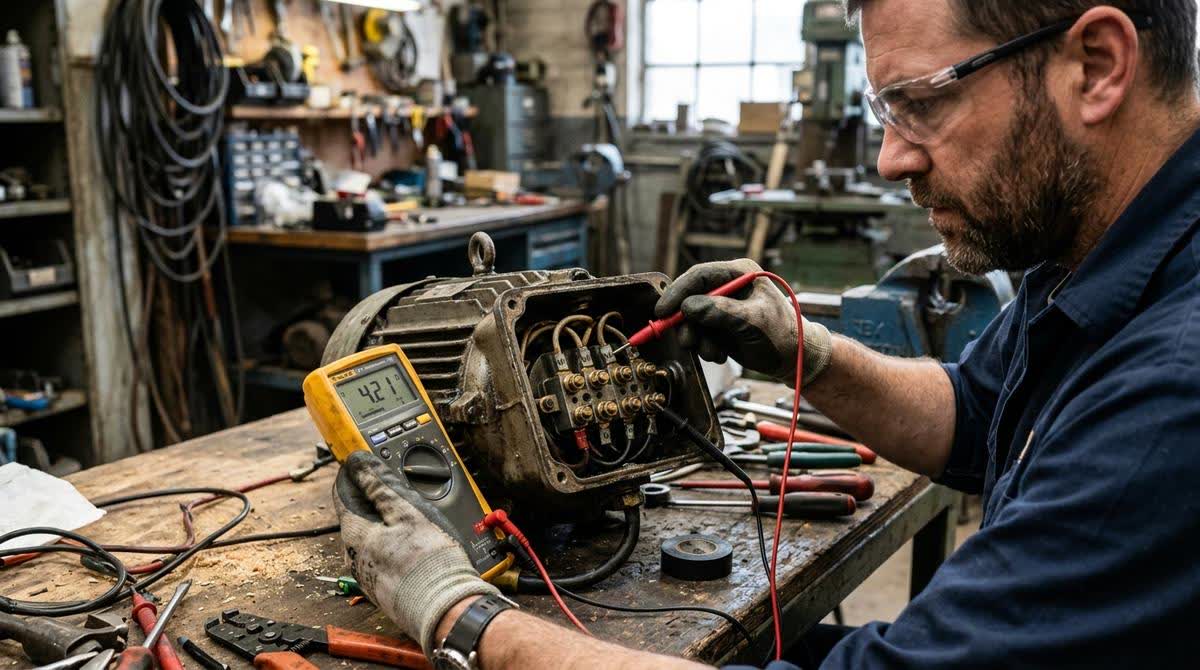
One of the most common and frustrating challenges on any job site is encountering an unlabeled motor. The nameplate, which should contain all critical information (voltage, current, power, RPM, connection type), is either corroded, scratched off, or simply missing. This turns what should be a simple connection task into a potentially dangerous guessing game. Connecting a motor incorrectly can lead to immediate failure, fire, or a dangerous electrical accident.
This guide provides a systematic, practical methodology for identifying the key parameters of an unlabeled three-phase induction motor. By combining basic electrical measurements with some logical deduction, you can confidently determine how to connect and operate the motor. This is a skill that separates the experienced electrician from the novice; it is based on an understanding of fundamental motor theory and the standard practices used by motor manufacturers.
Step 1: The Physical Inspection - What You Can Learn Without a Multimeter
Before you make any measurements, gather as much information as possible from the motor itself. The physical clues can be remarkably revealing.
Physical Clue What It Tells You
Motor Frame Size Larger frames indicate higher power (kW/HP). An IEC frame size (e.g., 90L, 132M) directly correlates with a power rating.
Number of Terminal Boxes If there are three terminal boxes, it's a single-speed motor with individual windings. If there are six, it's a two-speed motor. If there are nine or twelve, it's a multi-tap motor with complex connections.
Terminal Markings Look for any markings stamped near the terminals. For IEC motors, look for U1, V1, W1, U2, V2, W2. For NEMA motors, look for T1, T2, T3, T4, T5, T6.
Physical Size and Weight A motor with a larger diameter and heavier weight generally has a higher torque and power rating.
The Fan and Ventilation The size and design of the cooling fan can give an indication of the motor's duty cycle and power rating.
The Shaft Diameter Larger motors have larger shafts. This is a rough but useful indicator of power.
نصيØØ© الخبير: لا تستهن بقدرة "الØدس الهندسي" المبني على الخبرة. بمجرد النظر إلى Ù…Øرك، يمكن للمهندس المتمرس أن يخمن نطاق قدرته بدقة معقولة. هذه غريزة تتطور مع مرور الوقت وكثرة التعامل مع المØركات.
Step 2: The Electrical Measurements - A Systematic Approach
With the physical inspection complete, it is time to use the multimeter to gather the critical electrical data.
Procedure:
Step Action Purpose
1 Safety First: Ensure the motor is completely isolated from the power supply. Lock out and tag out the circuit.
2 Visual Check: Inspect the terminal box. Are the jumpers present? Are the terminals clearly marked? This will guide your measurement strategy.
3 Measure Winding Resistance (R): Set your multimeter to resistance (ohms). Measure the resistance between each pair of terminals. For a three-phase motor with six terminals (U1, V1, W1, U2, V2, W2):
- Measure U1-U2
- Measure V1-V2
- Measure W1-W2 This identifies the individual phase windings. All three readings should be roughly equal.
4 Measure Insulation Resistance (Megger Test): Use a megohmmeter (Megger) to test the insulation resistance between the windings and the motor frame (earth). This verifies the health of the motor's insulation. A reading below 1 Megaohm (for a low-voltage motor) indicates a problem.
5 Identify the Connection Type: Now, use the resistance measurements to determine the internal connection of the motor. In a three-phase motor, there are two fundamental connection methods: Star (Wye) and Delta (Mesh). You must know this to connect the motor to the correct supply voltage.
Understanding the Star (Wye) and Delta (Mesh) Connection
Star (Wye) Connection: All three phases are connected to a common point (the "neutral" or "star point"). The line voltage (V_L) is √3 times the phase voltage (V_Ph). The line current (I_L) equals the phase current (I_Ph).
Delta (Mesh) Connection: The phases are connected end-to-end to form a closed loop. The line voltage (V_L) equals the phase voltage (V_Ph). The line current (I_L) is √3 times the phase current (I_Ph).
The Key Insight: Motors are designed to operate at two voltages that are related by a factor of √3 (approximately 1.73). For example, a motor might be rated for 220V Delta and 380V Star, or 380V Delta and 660V Star. This is why you often see the notation 230V/400V on a nameplate.
How to Determine the Connection Type from Terminal Measurements
The process depends on how many terminals are accessible.
Number of Terminal Pairs Connection Type How to Identify
3 Terminals (U1, V1, W1) Internally Connected (Fixed Star or Delta) You cannot change the connection. The motor's internal windings are already connected in Star or Delta. You must connect the correct voltage.
6 Terminals (U1, V1, W1, U2, V2, W2) Externally Connectable (Star or Delta) This is the most common and flexible configuration. You can connect it in Star or Delta using external jumpers.
For a Motor with 6 Terminals, the Identification Process is:
Test Observation Conclusion
Measure resistance between U1-U2, V1-V2, W1-W2. All readings are equal (roughly 1-10 Ohms). You have identified the three individual phase windings.
Now, to identify the correct connection for the supply voltage: Measure the supply voltage of your network. This is a fixed value (e.g., 400V in most commercial buildings).
Connect the motor in Delta. If the motor runs smoothly and does not draw excessive current, it is likely the correct connection for the high-voltage network. If it runs very slowly or trips the breaker, you should try the Star connection. The correct connection is the one that allows the motor to reach its full rated speed (RPM) and power without overheating.
The "Dual-Voltage" Logic:
If the supply voltage is 400V:
Connect the motor in Star (Wye): This gives a phase voltage of V_Ph = V_L / √3 = 400 / 1.73 = 230V.
The motor will run safely at its rated power.
If the supply voltage is 230V:
Connect the motor in Delta (Mesh): This gives a phase voltage of V_Ph = V_L = 230V.
The motor will run safely at its rated power.
نصيØØ© الخبير: إذا كان لديك Ù…Øرك بـ 6 أطرا٠وغير متأكد من الجهد، ابدأ بتوصيله على شكل Star (نجمة). هذا هو الخيار الأكثر أماناً، Øيث يقلل الجهد على كل ملÙØŒ مما ÙŠØمي المØرك من الاØتراق ÙÙŠ Øالة التوصيل الخاطئ. إذا كان المØرك يعمل بشكل جيد تØت الØمل، Ùهذا يعني أنه مصمم للجهد العالي (مثل 380-400 Ùولت). إذا كان يعمل ببطء أو لا يصل إلى سرعته الكاملة، Ùهذا يعني أنه مصمم للجهد المنخÙض (مثل 220-240 Ùولت) ويجب تØويل التوصيل إلى Delta (مثلث).
Step 3: Determining the Motor's Power and RPM
Identifying the RPM (Speed):
The number of poles in the motor determines its synchronous speed. The formula for synchronous speed is:
Synchronous Speed (RPM) = (120 × Frequency) / Number of Poles
With a 50Hz supply (most of the Middle East):
2 Poles: 3000 RPM (Synch) / ~2850-2950 RPM (Full Load)
4 Poles: 1500 RPM (Synch) / ~1425-1475 RPM (Full Load)
6 Poles: 1000 RPM (Synch) / ~950-975 RPM (Full Load)
8 Poles: 750 RPM (Synch) / ~715-730 RPM (Full Load)
Estimating Power (kW/HP):
Estimating power from physical measurements is an art, but there are some reliable approximations.
Motor Type Physical Indicator Approximate Power (kW) per 100mm of Diameter
4-Pole (1500 RPM) Frame size, length, and shaft diameter. 5 - 7.5 kW (depending on length)
2-Pole (3000 RPM) Smaller frame for same power due to higher speed. 7.5 - 11 kW
6-Pole (1000 RPM) Larger frame for same power due to lower speed. 3 - 5.5 kW
The Final Lesson: The "Safe" Approach to Unlabeled Motors
The most important rule when dealing with an unlabeled motor is the "SMART" approach: Safety, Measurement, Analysis, Reasoning, and Testing.
Isolate and Lock Out: Never work on a live motor.
Measure and Record: Take resistance and megger readings. Write them down.
Analyze: Determine if the motor has 3, 6, or more terminals.
Reason: Apply the logic of Star and Delta connections in relation to your measured supply voltage.
Test: Always start by connecting the motor in Star. This is the safest configuration. Observe its performance under no load. If it runs smoothly, connect it under a partial load. If it struggles, reconnect it in Delta.
By following this systematic, safety-first process, you can confidently determine the specifications and connection of almost any unlabeled three-phase motor. This skill not only saves time and money but also prevents dangerous failures. At AllandMuchMore, our engineers are trained to approach every unknown component with this level of professionalism and safety.