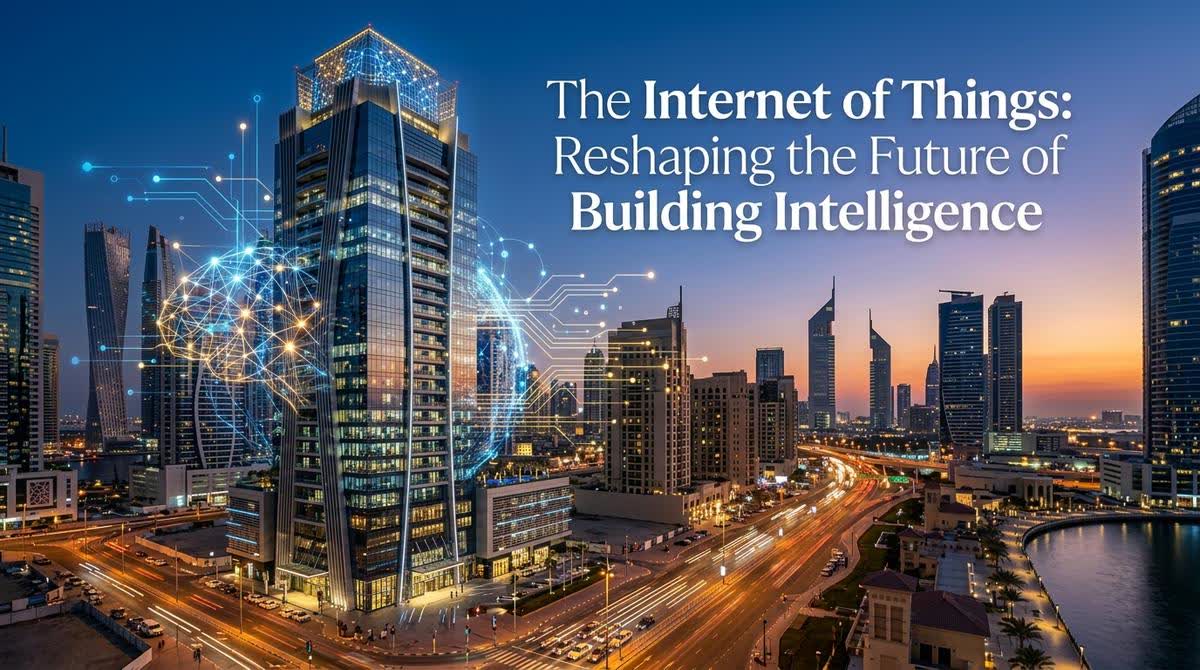
The Internet of Things: Reshaping the Future of Building Intelligence
The Internet of Things has emerged as one of the most transformative forces in the built environment, fundamentally changing how buildings are designed, operated, and experienced. What was once a collection of isolated systems has become an interconnected ecosystem where sensors, devices, and analytics work together to create intelligent, responsive spaces that adapt to the needs of occupants and operators alike.
For building owners, facility managers, and investors across the Middle East, understanding the implications of IoT is no longer optional but essential for maintaining competitive advantage in an increasingly sophisticated market. The region has embraced technological innovation with remarkable speed, and buildings that fail to incorporate IoT capabilities risk becoming obsolete in a market that increasingly demands intelligence, efficiency, and connectivity.
The Strategic Value of IoT in Buildings
The value proposition of IoT extends far beyond simple automation, touching virtually every aspect of building performance and user experience in ways that were unimaginable just a decade ago.
Operational Efficiency at Scale
IoT enables a level of operational visibility and control that was previously impossible to achieve. Sensors distributed throughout the building provide real-time data on everything from equipment performance to environmental conditions. This data enables facility managers to identify issues before they become problems, optimize maintenance schedules based on actual equipment condition rather than arbitrary timelines, and make informed decisions that improve building performance. For a typical 50,000 square meter commercial building in Dubai or Riyadh, the operational savings from IoT-enabled management can reach 200,000 to 500,000 dollars annually, representing a significant contribution to the bottom line.
Energy Optimization and Sustainability
Energy costs in the Middle East, while relatively lower than in Europe or North America, still represent a substantial portion of operating expenses for commercial and residential buildings. IoT enables sophisticated energy management strategies that reduce consumption without compromising comfort. Lighting adjusts based on occupancy and natural light availability. HVAC systems respond to real-time occupancy data rather than fixed schedules. Equipment operates at optimal efficiency based on actual demand. The cumulative effect is typically a reduction in energy consumption of twenty to thirty percent, which for a large commercial building translates to annual savings of 100,000 to 300,000 dollars depending on local utility rates.
Enhanced User Experience
The expectations of building occupants have evolved significantly, particularly in markets like the UAE and Saudi Arabia where international standards of quality are the norm. IoT enables personalized experiences that were previously impossible to deliver. Temperature, lighting, and even air quality can be adjusted to individual preferences. Space utilization can be optimized based on actual usage patterns. Wayfinding and navigation can be enhanced through indoor positioning systems. These capabilities not only improve occupant satisfaction but also contribute to tenant retention and premium rental rates.
Predictive Maintenance and Asset Management
Equipment failures in buildings are not only costly to repair but also disruptive to operations. IoT enables predictive maintenance that identifies potential failures before they occur, allowing repairs to be scheduled during planned maintenance windows rather than in response to emergency breakdowns. Vibration sensors on rotating equipment, temperature monitoring on critical systems, and power quality analysis on electrical distribution all contribute to a comprehensive picture of equipment health. For a typical commercial building, predictive maintenance can reduce maintenance costs by fifteen to twenty-five percent while extending equipment life by ten to fifteen years.
The IoT Ecosystem in Buildings
Understanding the components of the IoT ecosystem is essential for making informed investment decisions about building technology.
Sensors and Actuators
Sensors are the eyes and ears of the IoT system, collecting data on building conditions and performance. Temperature sensors, humidity sensors, occupancy detectors, light sensors, and air quality monitors all contribute to the comprehensive data picture. Actuators are the hands of the system, executing commands based on the intelligence derived from sensor data. Smart lighting controls, motorized dampers, variable frequency drives, and smart valves all translate digital commands into physical actions.
Connectivity Infrastructure
The connectivity infrastructure is the nervous system of the IoT ecosystem, transmitting data from sensors to processing systems and commands from processing systems to actuators. Wired connections such as Ethernet and BACnet provide reliable, high-bandwidth communication for critical systems. Wireless connections such as Wi-Fi, Zigbee, and LoRaWAN provide flexibility for sensors and devices where wiring is impractical. The choice of connectivity technology depends on the specific requirements of each application, including bandwidth, range, power consumption, and reliability.
Data Processing and Analytics
The data collected by sensors is only as valuable as the intelligence extracted from it. Edge processing performs initial analysis close to the source, enabling rapid response to critical events. Cloud-based processing provides the capacity for more sophisticated analysis and long-term storage. Machine learning algorithms identify patterns and relationships that would be impossible for humans to detect. Predictive models anticipate future conditions based on historical data. The analytics layer transforms raw data into actionable intelligence.
Management and User Interfaces
The management interface provides facility operators with visibility and control over building systems. Dashboards display key performance indicators, alert operators to issues, and enable manual intervention when needed. User interfaces provide building occupants with control over their environment, from smartphone applications to wall-mounted touch panels. The interface layer must be intuitive and responsive, ensuring that the intelligence of the system is accessible to its users.
Implementation Considerations for the Middle East
The Middle East presents unique opportunities and challenges for IoT implementation that must be carefully considered.
Climate Considerations
The extreme climate of the region places significant demands on building systems, particularly in the areas of cooling and energy management. IoT-enabled cooling optimization can reduce energy consumption by twenty percent or more while maintaining occupant comfort. Humidity monitoring and control are essential for both occupant comfort and preservation of building materials. The harsh outdoor environment requires robust, weather-resistant sensors and equipment that can withstand high temperatures and sand exposure.
Market Characteristics
The Middle East market is characterized by ambitious development projects, rapid growth, and a strong appetite for innovation. Building owners and developers in the region are increasingly expecting IoT capabilities as standard features rather than optional upgrades. Competition is intense, and properties that incorporate advanced technology command premium prices and attract quality tenants. The investment in IoT is not merely about operational savings but about market positioning and competitive differentiation.
Cost Considerations
The cost of IoT implementation in the Middle East varies depending on the scope of the project and the specific technologies deployed. For a typical commercial building, the investment in IoT sensors, connectivity infrastructure, and analytics platforms typically ranges from 10 to 25 dollars per square meter. This investment yields returns through energy savings, maintenance reduction, and operational efficiency improvements, with payback periods typically ranging from two to four years. The long-term value extends far beyond the initial payback period.
Integration with Building Systems
IoT is not a standalone system but an enhancement to existing building systems. Integration with BMS, lighting control, access control, and other systems is essential for realizing the full value of IoT investment. The integration must be seamless and reliable, ensuring that data flows freely between systems and that intelligence from one system informs the operation of others. Open standards and protocols facilitate integration and protect against vendor lock-in.
Future Trends in Building IoT
The evolution of IoT in buildings continues at a rapid pace, with several trends shaping the future.
Artificial Intelligence and Machine Learning
AI and machine learning are transforming IoT from descriptive to predictive and prescriptive capabilities. Systems are learning from historical data to predict future conditions, optimize operation, and identify anomalies. Natural language processing is enabling more intuitive user interfaces. Computer vision is providing new capabilities for occupancy detection and security. The integration of AI is the next frontier in building intelligence.
Digital Twins
Digital twin technology creates virtual representations of buildings that reflect their physical condition and operation in real time. These models enable simulation, optimization, and training without impacting actual operations. Predictive analysis can be performed on the digital twin before being implemented in the physical building. Digital twins represent a significant advancement in building management capability.
5G Connectivity
The deployment of 5G networks is enabling new IoT capabilities with higher bandwidth, lower latency, and support for more devices. 5G enables real-time control of building systems, high-definition video analytics, and support for dense sensor networks. The improved connectivity enables new applications and more sophisticated capabilities.
Cybersecurity Focus
As buildings become more connected, cybersecurity becomes increasingly critical. IoT devices present potential entry points for cyber attacks that could compromise building operations or data security. Security must be designed into IoT systems from the beginning, not added as an afterthought. Encryption, authentication, and monitoring are essential components of secure IoT implementation.
The AllandMuchMore Perspective
At AllandMuchMore, we understand the transformative potential of IoT in building management. Our approach reflects our deep understanding of the technology and the market.
Strategic Assessment
We begin by understanding your building requirements, operational objectives, and investment parameters. We assess the current state of your building systems and identify opportunities for IoT enhancement. Our recommendations are grounded in business case analysis that considers both costs and benefits.
System Design
We design IoT solutions that meet your specific requirements and integrate with your existing systems. Our designs reflect best practices and industry standards. We consider current needs and future evolution. Our designs are practical, scalable, and cost-effective.
Quality Implementation
Our experienced teams deliver quality installation and commissioning. We ensure that all sensors, connectivity infrastructure, and analytics platforms operate as designed. Our testing and verification processes ensure reliability and performance.
Ongoing Support
We provide comprehensive training and ongoing support. We help you optimize system performance and realize the full value of your IoT investment. Our relationship extends beyond installation.
In the End :
The Internet of Things is reshaping the future of building intelligence, enabling levels of efficiency, sustainability, and user experience that were previously impossible. For building owners, operators, and investors in the Middle East, embracing IoT is essential for maintaining competitive advantage and positioning properties for future success.
Buildings equipped with comprehensive IoT capabilities command premium prices, attract quality tenants, and operate more efficiently. The investment in IoT yields returns through energy savings, maintenance reduction, and operational efficiency improvements. The long-term value extends far beyond the initial investment.
At AllandMuchMore, we have the expertise to help you harness the power of IoT for your buildings. Our comprehensive approach covers everything from strategic planning through ongoing support. When you work with us, you are investing in the future of building intelligence.