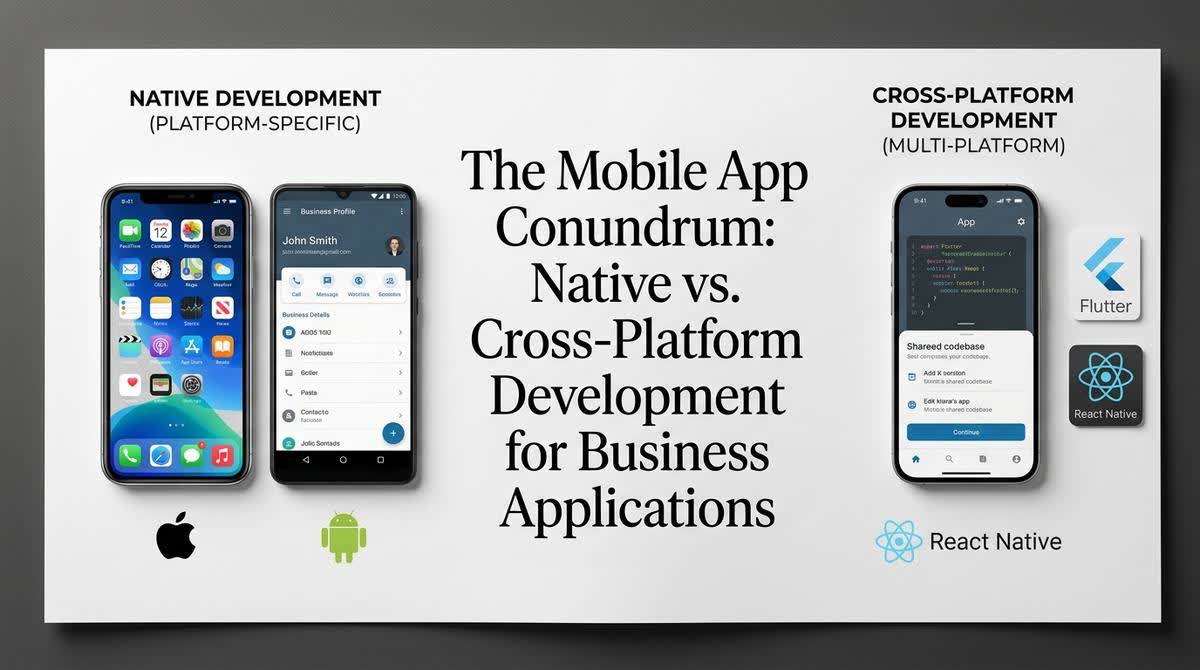
The decision to build a mobile application is a significant strategic investment for any business. But the decision does not stop there. One of the most critical early choices is the development approach: should you build a native application for each platform (iOS and Android), or should you use a cross-platform framework to build a single codebase that works on both?
There is no single "right" answer to this question. The best choice depends on the specific requirements of the application, the budget, the timeline, and the long-term strategic goals of the business. This article provides a framework for making this critical decision, weighing the trade-offs of each approach.
Understanding the Two Approaches
1. Native Development
Native development involves writing separate codebases for each platform. You use Swift or Objective-C for iOS and Kotlin or Java for Android. Each app is built using the platform's specific tools, SDKs, and languages, which gives you full access to all of the device's features and a seamless user experience.
Pros: Access to all device features (camera, GPS, sensors). Superior performance and smooth animations. Best possible user experience with platform-specific UI components. Easier to implement advanced features like AR/VR. Often has better developer tooling and debugging support.
Cons: Higher development cost (two teams or two sets of skills). Longer development time. Maintaining two separate codebases is more complex. Requires specialized developers for each platform.
2. Cross-Platform Development
Cross-platform development involves writing a single codebase (often in a language like JavaScript, Dart, or C#) that can be compiled to run on both iOS and Android. Popular frameworks include React Native, Flutter, Xamarin, and Ionic.
Pros: Lower development cost (one team or one set of skills). Faster development time. Easier maintenance (one codebase to update). Ability to reuse code and logic across platforms.
Cons: Potential performance limitations for complex or graphics-intensive applications. May not have immediate access to the newest platform features. Potential for "friction" in the user experience (app may not feel "native" on each platform). Dependency on the cross-platform framework.
A Decision Framework
The choice between native and cross-platform is not a one-size-fits-all decision. Use the following framework to evaluate your specific needs.
Criteria 1: Application Complexity and Performance Requirements
Application Type Recommended Approach Rationale
Simple, Data-Driven Apps (e.g., Company Directory, Basic Catalog) Cross-Platform The performance requirements are low. The logic is straightforward. The cost and speed benefits of cross-platform are significant.
Medium Complexity Apps (e.g., Booking App, Social Feed) Cross-Platform or Native Can be done with cross-platform, but be mindful of UI/UX. Native offers a smoother experience. The choice depends on budget and timeline.
High-Performance Apps (e.g., Games, Real-Time Data, AR/VR) Native Performance is critical. Cross-platform frameworks cannot yet match the native performance and access to the metal.
Device Feature-Heavy Apps (e.g., Camera, GPS, Sensors) Native (or Cross-Platform with caution) Native offers the most reliable and immediate access to device features. Cross-platform plugins can be used, but they may be buggy or have latency issues.
Criteria 2: Budget and Timeline
Factor Native Cross-Platform
Initial Development Cost Higher (two teams). Lower (one team).
Maintenance Cost Higher (two codebases). Lower (one codebase).
Time to Market Slower (two development cycles). Faster (one development cycle).
Criteria 3: User Experience (UX) and Design Requirements
Requirement Native Cross-Platform
Platform-Specific UI/UX Native provides the best platform-specific UI/UX. Cross-platform can replicate native UI/UX but may not feel "perfect."
Consistent Experience Across Platforms More difficult to achieve a consistent look and feel across platforms. Easier to achieve a consistent experience across platforms.
Accessibility Features Native provides comprehensive platform-specific accessibility features. Cross-platform frameworks are catching up but may not have full support for all accessibility features.
Criteria 4: Team Expertise and Long-Term Strategy
Factor Native Cross-Platform
Team Composition Requires specialized iOS and Android developers. Requires developers with experience in a specific cross-platform framework.
Hiring Complexity More difficult to find two specialized skills. Easier to find one skill (e.g., React Native developers are more common).
Long-Term Maintenance Maintaining two codebases is more complex. Maintaining one codebase is simpler.
Future Evolution You are dependent on Apple and Google's ecosystem. You are dependent on the cross-platform framework's ecosystem.
The Framework for Decision-Making
Step Question to Ask
1 What is the primary purpose of this app? Is it a simple utility, a data-display tool, or a complex, interactive application?
2 What is the budget? How much can we invest in the initial development and ongoing maintenance?
3 What is the timeline? Do we need to launch as quickly as possible?
4 How important is performance? Will the app be handling complex computations, gaming, or high-quality video?
5 How important is the user experience? Does it need to feel "native" to each platform?
6 What are our long-term goals? Do we need the flexibility to adapt quickly? Do we plan to add complex, platform-specific features in the future?
7 What skills do our teams have? Do we have, or can we hire, specialized native developers?
The AllandMuchMore Approach
At AllandMuchMore, we take a strategic approach to mobile app development. We do not have a "preferred" approach; instead, we work with our clients to understand their specific requirements and recommend the best approach for their situation. We have experience with both native and cross-platform development and can help you navigate this critical decision.
The Final Lesson: There Is No Silver Bullet
The choice between native and cross-platform is a strategic trade-off. Each approach has its strengths and weaknesses. The key is to understand your specific requirements and choose the approach that best aligns with your business goals. At AllandMuchMore, we are technology-agnostic, focusing on delivering the best solution for our clients.