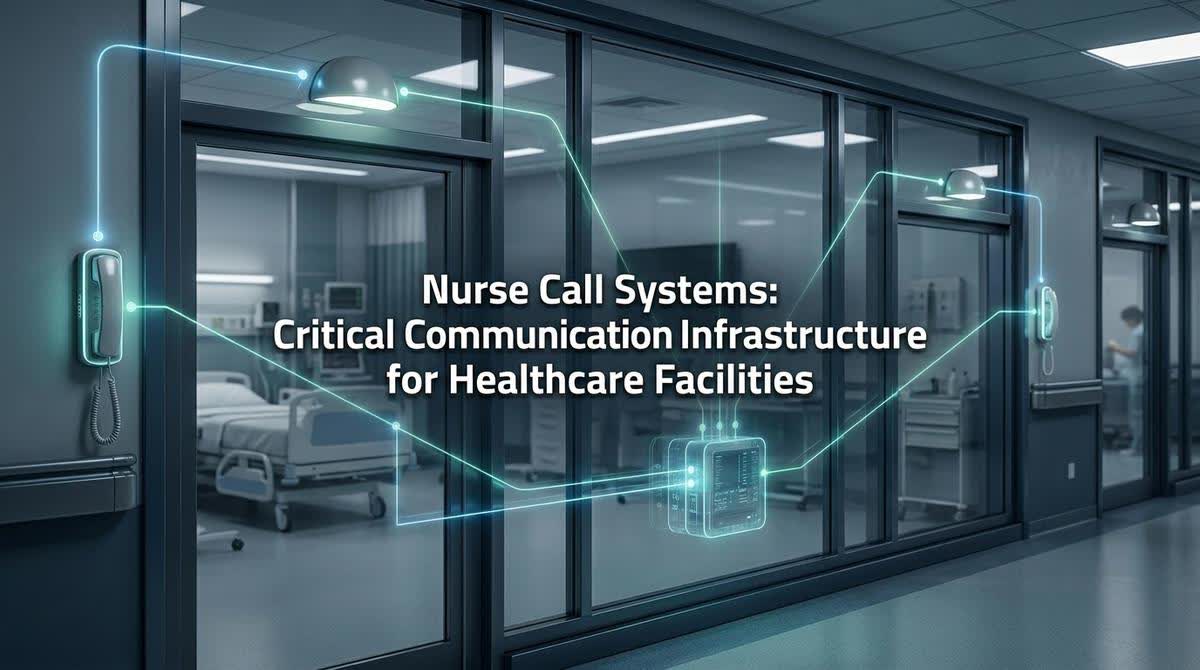
Nurse Call Systems: Critical Communication Infrastructure for Healthcare Facilities
Nurse Call Systems are among the most critical systems in any healthcare facility.
They are the communication lifeline between patients and caregivers, directly impacting patient safety, care quality, and operational efficiency.
For healthcare administrators, facility managers, and clinical leaders, understanding nurse call systems is essential.
The stakes in healthcare facilities are different from those in other building types.
Patient safety is paramount.
Response times can mean the difference between positive and negative outcomes.
Communication failures can have serious consequences.
Nurse Call Systems must be reliable, responsive, and effective.
The Strategic Importance of Nurse Call Systems
Nurse Call Systems play a critical role in healthcare facility operations.
Patient Safety
Patient safety is the primary purpose of nurse call systems.
When patients need assistance, the system must enable rapid response.
Delays can compromise patient safety.
The system must be reliable and responsive.
Care Quality
Quality of care depends on effective communication.
Nurse call systems enable caregivers to respond promptly to patient needs.
Response time is a key quality indicator. The system supports quality care.
Operational Efficiency
Healthcare facilities operate under significant resource constraints.
Efficient operations are essential. Nurse call systems support efficient resource allocation.
Caregivers can prioritize response based on urgency.
Staff Satisfaction
Healthcare staff work in demanding environments.
Effective communication systems reduce stress and improve job satisfaction.
Staff can provide better care with reliable systems.
Staff retention benefits from effective systems.
Patient Satisfaction
Patient satisfaction is increasingly important.
Patients evaluate their experience based on many factors.
Effective communication contributes to satisfaction.
Positive experiences support reputation and revenue.
Understanding Nurse Call System Architecture
Modern Nurse Call Systems consist of integrated components that work together to deliver reliable communication.
Patient Stations
Patient stations are the primary point of communication for patients.
Located at bedsides and in bathrooms, they enable patients to request assistance.
Emergency pull cords provide additional capability.
Patient stations must be accessible and intuitive.
Staff Stations
Staff stations provide communication capability for caregivers.
Located at nursing stations and throughout units, they enable staff to respond to calls.
Staff stations display call information and enable communication with patients.
Visual Indicators
Visual indicators provide visible notification of call status.
Room lights indicate call activity in patient rooms.
Corridor displays show call status throughout the unit.
Visual indicators enable rapid identification of call locations.
Audible Notification
Audible notification provides aural alerts for staff.
Local tones indicate call status in patient rooms.
Staff can hear call activity throughout the unit.
Audible notification supports rapid response.
Central Management
Central management provides supervision and control.
Nursing station consoles display call status and management features.
Call history and reporting support quality monitoring.
Central management enables oversight.
System Integration
Integration capabilities extend system functionality.
Integration with hospital information systems provides patient data.
Integration with telephony enables wireless notification.
Integration with location services enables staff tracking.
Key Capabilities and Features
Modern Nurse Call Systems provide a comprehensive set of capabilities.
Priority Call Handling
Calls are prioritized based on urgency.
Emergency calls receive highest priority and immediate attention.
Routine calls are handled according to standard procedures.
Priority handling ensures appropriate response.
Two-Way Communication
Two-way audio communication between patients and staff is essential.
Patients can speak with caregivers directly.
Staff can communicate with patients without entering the room.
Effective communication supports efficient response.
Wireless Staff Notification
Staff can receive call notifications on wireless devices.
Mobile phones and pagers enable staff to respond from anywhere.
Staff can acknowledge calls remotely.
Wireless notification improves response efficiency.
Call Logging and Reporting
All call activity is logged for review.
Call history supports quality monitoring and improvement.
Reports can be generated for management review.
Data supports continuous improvement.
Integration with Patient Data
Patient data integration provides context for calls.
Staff can view patient information before entering the room.
Patient history supports effective care.
Integration improves care quality.
Configuration and Management
System configuration supports facility requirements.
Call priorities, notification methods, and response procedures are configurable.
System management enables adaptation to changing needs.
Design Considerations
Nurse Call System design must address the unique requirements of healthcare facilities.
Unit Layout Considerations
Unit layout affects system design.
Room locations, corridor configurations, and nursing station placement are significant.
The system must support efficient communication within the layout.
Patient Population Requirements
Patient populations have different needs.
Critical care units require different capabilities than general wards.
Pediatric units need age-appropriate solutions.
System design must address specific patient needs.
Staff Workflow Integration
The system must integrate with staff workflows.
Staff movement patterns affect communication requirements.
Notification methods must support work habits.
Integration improves efficiency.
Regulatory Compliance
Healthcare facilities must comply with regulations.
Life safety codes, patient privacy requirements, and healthcare standards apply.
System design must ensure compliance.
Future Flexibility
Healthcare facilities evolve over time.
Renovations, service changes, and technology evolution are constant.
System design should accommodate future change.
Flexibility protects investment.
Implementation Process
Successful implementation requires careful planning and execution.
Requirements Definition
Begin by defining facility requirements.
Understand patient needs and staff workflows.
Identify regulatory requirements.
Document performance expectations.
System Selection
Select a system that meets facility requirements.
Consider vendor capabilities and support.
Evaluate system features and performance.
Choose a system with appropriate scalability.
Installation Planning
Plan installation to minimize operational disruption.
Coordinate with construction schedules.
Plan for commissioning and testing.
Schedule installation to avoid impacting care delivery.
Installation and Configuration
Install system components according to plan.
Configure system for facility requirements.
Test all components and functions.
Address any issues identified.
Staff Training
Provide comprehensive training for all users.
Clinical staff must understand system operation.
Support staff must understand their roles.
Documentation must be complete and accessible.
Go-Live Support
Provide support during system transition.
Address issues promptly.
Ensure patient and staff needs are met.
Monitor system performance.
Post-Implementation Review
Review system performance after implementation.
Identify any issues or improvement opportunities.
Adjust configuration as needed.
Document lessons learned.
Maintenance and Support
Ongoing maintenance and support are essential for system reliability.
Preventive Maintenance
Follow manufacturer recommendations for maintenance.
Test system components regularly.
Address issues before they affect operation.
Maintenance records should be maintained.
Corrective Maintenance
Respond promptly to system issues.
Diagnose problems and implement fixes.
Document repairs and troubleshooting.
Ensure system reliability.
System Updates
Apply system updates to maintain performance.
Security patches protect against vulnerabilities.
Feature updates improve capability.
Test updates before deployment.
User Support
Provide ongoing support for system users.
Address questions and issues promptly.
Maintain user documentation.
Support user needs.
Performance Monitoring
Monitor system performance continuously.
Identify any degradation or issues.
Address performance problems proactively.
Maintain performance standards.
Common Challenges and Solutions
Challenge: Staff Adoption
Staff may resist using new systems.
Solution:Â Provide comprehensive training and support.
Involve staff in system selection and design.
Address concerns and questions.
Demonstrate system benefits.
Challenge: Integration Complexity
Integration with hospital systems can be complex.
Solution:Â Specify integration requirements clearly.
Test integration thoroughly.
Document integration configuration.
Provide integration support.
Challenge: System Reliability
Healthcare operations depend on system reliability.
Solution:Â Implement redundant systems where appropriate.
Maintain backup capability.
Test system reliability regularly.
Address issues promptly.
Challenge: Changing Requirements
Healthcare needs change over time.
Solution:Â Design systems for flexibility.
Plan for system evolution.
Maintain upgrade paths.
Adapt to changing requirements.
Challenge: Budget Constraints
Budget limitations affect system capabilities.
Solution:Â Prioritize critical functions.
Phase implementation where appropriate.
Focus on core requirements.
Demonstrate value to justify investment.
The AllandMuchMore Perspective
At AllandMuchMore, we understand the critical importance of Nurse Call Systems in healthcare facilities.
Our approach reflects this understanding.
Requirements Understanding
We understand healthcare facility requirements.
We know the regulatory environment.
We understand staff workflows and patient needs.
Our approach is healthcare-focused.
System Design
We design systems that meet facility requirements.
Our designs reflect best practices.
We consider reliability, performance, and user experience.
Our designs are practical and maintainable.
Quality Implementation
Our experienced teams deliver quality installation.
We commission systems thoroughly.
Our documentation is complete and accurate.
We ensure system reliability.
Ongoing Support
We provide comprehensive training and support.
We help you maintain system performance.
Our relationship extends beyond installation.
In the End :
Nurse Call Systems are critical infrastructure in healthcare facilities.
They directly impact patient safety, care quality, and operational efficiency.
Investment in quality nurse call systems is essential for healthcare facilities.
Healthcare facilities that invest in effective nurse call systems improve patient safety and care quality.
They achieve operational efficiency and staff satisfaction.
Their investment supports patient satisfaction and facility reputation.
At AllandMuchMore, we have the expertise to help you implement effective Nurse Call Systems.
Our comprehensive approach covers everything from requirements definition through ongoing support.
When you work with us, you are investing in patient safety and care quality.