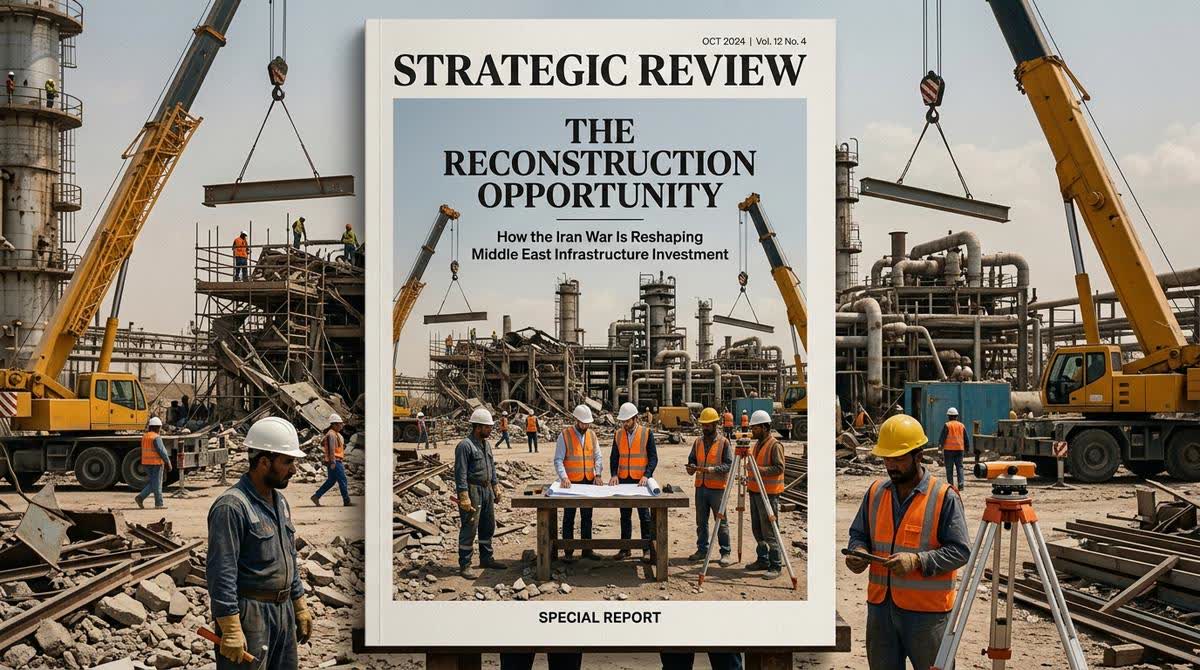
Every crisis contains the seeds of opportunity. The Iran war, for all its devastation, has created a massive reconstruction opportunity that will reshape the Middle East infrastructure landscape for decades to come. The scale of the rebuilding effort is unprecedented, and it presents significant opportunities for companies with the capability to deliver.
The damage is extensive. According to the International Energy Agency, 84 energy facilities across the region sustained damage, with 34 classified as seriously or completely damaged. Consultancy Rystad Energy estimated repair costs for damaged energy infrastructure at between $34 billion and $58 billion.
But the damage extends far beyond energy infrastructure. Ports, airports, industrial facilities, and data centers were all targeted. The reconstruction effort will be massive and multi-faceted, creating opportunities across the entire infrastructure spectrum.
The Scale of the Opportunity
The numbers paint a picture of the scale of the reconstruction opportunity:
Sector | Estimated Damage/Need | Source |
|---|---|---|
Energy Infrastructure | $34-58 billion in repairs | Rystad Energy |
Arab Region GDP Loss | $120-194 billion in one month | UNDP |
GCC Economic Loss | 5.2-8.5% of GDP | UNDP |
Regional Job Losses | 3.7 million | UNDP |
The reconstruction effort will not simply rebuild what was destroyed. It will be an opportunity to modernize, upgrade, and future-proof infrastructure across the region.
The US-Iran Framework Agreement: A $300 Billion Fund
In June 2026, news emerged of a framework agreement between the US and Iran that included the creation of a $300 billion fund to promote investment in Iran. According to Reuters, preliminary estimates indicated that investments would focus on energy, logistics, manufacturing, and transportation.
The fund mechanism envisions regional countries participating through various means, including securing loans, establishing credit lines, or directly financing the reconstruction of sites damaged in the war. Facilities such as the Mobarakeh Steel complex, refineries, airports, and other infrastructure affected by the conflict are all potential beneficiaries.
The Trump administration was also seeking to use frozen Iranian assets to rebuild the energy and other infrastructure of Gulf states. The US Treasury Department planned to use "all its authority" to utilize Iranian assets for reconstruction and repair efforts.
The Changing Energy Landscape
The war has exposed the vulnerability of relying on a single maritime route for energy exports. This has accelerated efforts to diversify export routes and develop alternative energy sources.
Pipeline Development
One of the key features of the new regional order will be investment in new pipelines and energy projects. The conflict exposed the problem countries face in relying on one maritime method of exporting oil. Countries are now looking to develop alternative trade routes and corridors.
Renewable Energy Acceleration
The energy shock has also accelerated the transition to renewable energy. High oil prices make renewable alternatives more economically competitive. Gulf countries are likely to accelerate their investments in solar, wind, and other renewable sources to reduce dependence on fossil fuels.
Nuclear Energy Reconsideration
Some Gulf countries may reconsider their positions on nuclear energy as a way to diversify their energy mix and reduce dependence on imported fuels.
The Technology and Digital Infrastructure Opportunity
The attacks on data centers have highlighted the need for more resilient digital infrastructure. This creates opportunities in several areas:
1. Data Center Reconstruction and Hardening
Companies will need to rebuild damaged facilities with enhanced physical security measures. This includes blast-resistant construction, redundant systems, and distributed architectures.
2. Edge Computing and Distributed Infrastructure
The vulnerability of centralized data centers may accelerate the trend toward edge computing, with smaller facilities distributed across multiple locations to reduce concentration risk.
3. Domestic Technology Capabilities
Gulf countries may accelerate efforts to develop domestic technology capabilities to reduce dependence on foreign providers. This creates opportunities for local technology companies and joint ventures.
4. Cybersecurity Infrastructure
The war has highlighted the importance of cybersecurity in protecting critical infrastructure. Investment in cybersecurity capabilities will be a priority.
The ELV and Systems Integration Opportunity
For companies like AllandMuchMore that specialize in ELV systems and infrastructure integration, the reconstruction effort presents significant opportunities:
1. Building Management Systems (BMS)
Damaged facilities will need new or upgraded BMS to optimize energy efficiency and operational performance.
2. Security Systems
Enhanced physical and electronic security systems will be required for reconstructed facilities.
3. Communications Infrastructure
Damaged communications networks will need to be rebuilt, often with upgraded capabilities.
4. Smart Infrastructure
The reconstruction effort provides an opportunity to implement smart infrastructure solutions that improve efficiency and resilience.
5. Integration Services
The complexity of the reconstruction effort will require sophisticated integration services to ensure that all systems work together effectively.
The Human Capital Challenge
The reconstruction effort will require significant human capital. With 3.7 million jobs lost during the conflict, there is a large available workforce. However, the skills mismatch may be significant. The reconstruction effort will require skilled engineers, technicians, and project managers, many of whom may have left the region during the conflict.
Companies that can attract and retain skilled talent will have a competitive advantage in the reconstruction effort.
The Long-Term Strategic Implications
The reconstruction effort is not just about repairing damage. It is about reshaping the region's economic and strategic landscape.
1. Economic Diversification Acceleration
The war has accelerated the need for economic diversification. Countries that were already pursuing diversification strategies will intensify their efforts. This creates long-term opportunities in non-oil sectors, including technology, tourism, and manufacturing.
2. Regional Integration
The war has highlighted the interconnectedness of regional economies. Reconstruction efforts may foster greater regional integration, with countries cooperating on infrastructure projects.
3. Security Realignment
The war has prompted a reassessment of security alliances. Gulf states are questioning their reliance on US security guarantees. This may lead to new security arrangements and increased defense spending.
4. Technology Sovereignty
The war has highlighted the risks of depending on foreign technology providers. Countries may accelerate efforts to develop domestic technology capabilities, creating opportunities for local companies.