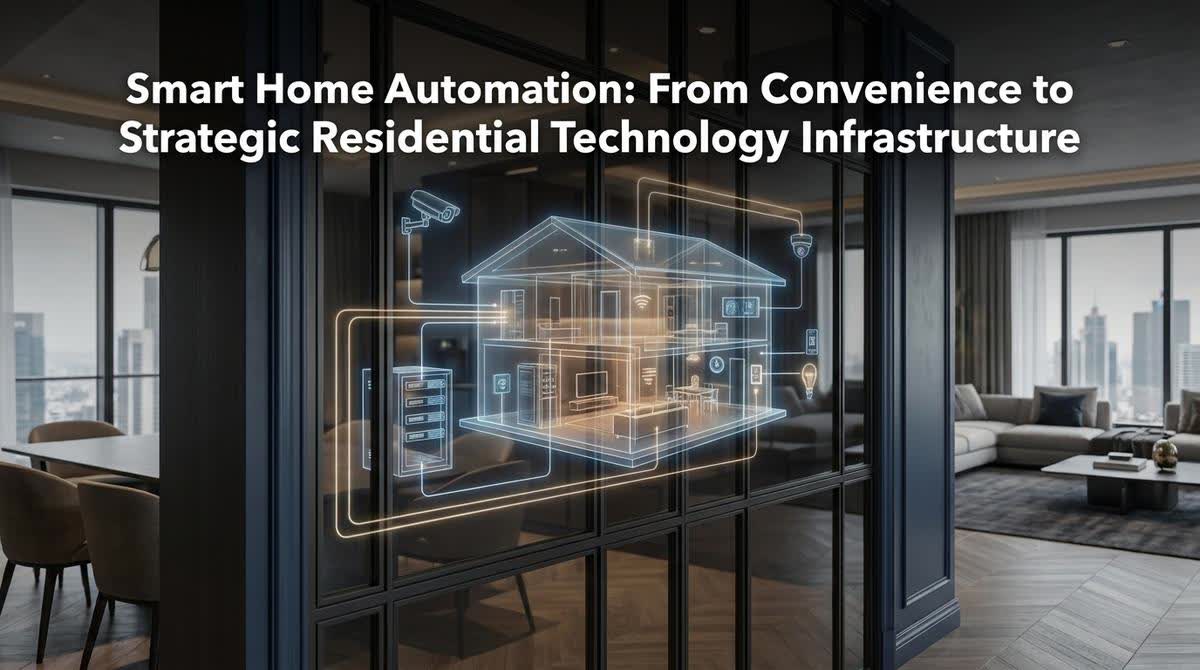
Smart Home Automation: From Convenience to Strategic Residential Technology Infrastructure
Smart home automation has undergone a remarkable transformation over the past decade.
What was once viewed as a luxury for technology enthusiasts has become an expectation in premium residential developments. Homebuyers increasingly demand homes that are connected, intelligent, and responsive.
For developers, owners, and investors, understanding the strategic implications of home automation is essential.
The residential market has experienced a fundamental shift in expectations.
Buyers are no longer satisfied with homes that simply provide shelter.
They want homes that enhance their lifestyle, improve security, and deliver convenience.
Smart home automation meets these expectations while providing tangible benefits for developers and investors.
The Strategic Value Proposition
Smart home automation delivers value across multiple dimensions, making it a strategic investment for residential developments.
Market Differentiation
In competitive real estate markets, smart home automation provides differentiation.
Developments that offer comprehensive automation command premium prices and attract quality buyers.
The technology investment typically yields returns through higher sales prices and faster sales cycles.
Property Valuation Enhancement
Properties with modern automation systems command higher valuations.
Appraisers recognize the value of integrated technology infrastructure.
The investment in automation often yields returns that exceed the cost.
Lifestyle Enhancement
Residents benefit from enhanced comfort, convenience, and security.
Automated lighting, climate control, entertainment, and security systems improve daily life.
The technology supports the lifestyle that buyers expect.
Energy Efficiency
Smart home automation supports energy efficiency.
Automated lighting, intelligent climate control, and energy monitoring reduce consumption.
Residents benefit from lower utility bills while supporting sustainability.
Future-Proofing
Properties with well-designed automation infrastructure are positioned for future technology evolution.
The underlying infrastructure supports new capabilities without major renovation.
This protects property value over time.
Understanding Smart Home Architecture
Smart home automation systems consist of several integrated components.
Understanding this architecture is essential for strategic decisions.
Core Components
The Automation Hub
The automation hub serves as the central intelligence of the system.
It receives inputs from sensors and user interfaces, processes information, and controls devices throughout the home.
The hub may be a physical device or software running on a server.
User Interfaces
Residents interact with the system through various interfaces.
Smartphone applications, wall-mounted touch panels, voice control, and traditional switches all provide access.
The user experience must be intuitive and responsive.
Sensors and Detectors
Sensors provide the system with awareness of conditions throughout the home.
Motion detectors, temperature sensors, light sensors, and door contacts enable automated responses.
The sensor network creates the intelligence of the home.
Actuators and Controllers
Actuators execute commands from the automation system.
Smart light switches, smart thermostats, motorized blinds, and smart locks translate digital commands into physical actions.
The actuator network enables automation.
Communication Infrastructure
Reliable communication between components is essential.
Wired and wireless networks provide the connectivity.
The infrastructure must support current devices and future additions.
Communication Protocols
Wi-Fi
Wi-Fi provides high-bandwidth connectivity for data-intensive devices.
Video streaming, music systems, and internet-connected devices rely on Wi-Fi.
Proper Wi-Fi coverage throughout the home is essential.
Zigbee and Z-Wave
These protocols provide low-power, reliable communication for sensors and devices.
They are widely supported by automation products.
They provide mesh networking for extended coverage.
Bluetooth
Bluetooth provides short-range communication for proximity-based features.
Occupancy detection and location services use Bluetooth.
It complements other protocols.
Wired Infrastructure
Wired connections provide the most reliable communication.
Structured cabling supports automation hubs, controllers, and network infrastructure.
Proper cabling is essential for reliability.
Design Principles for Home Automation
Successful home automation requires thoughtful design that addresses resident needs and technical requirements.
User Experience Focus
The user experience must be intuitive and accessible.
Residents of all ages and technical abilities should be able to use the system.
Interfaces should be consistent and responsive.
Reliability Priority
Home automation systems must be reliable.
Residents depend on the system for lighting, climate, and security.
Failures are unacceptable and damage confidence in the technology.
Scalability Design
The system should accommodate growth and evolution.
New devices and capabilities can be added over time.
The infrastructure should support future expansion.
Integration Capability
The system should integrate devices from multiple manufacturers.
Open standards support flexibility.
Proprietary systems limit options and increase costs.
Security Consideration
Home automation systems must be secure.
Connected devices can be vulnerable to attack.
Security must be designed in, not added later.
Key Home Automation Systems
Lighting Control
Automated lighting is the most common home automation application.
Lighting can respond to occupancy, time of day, and user preferences.
Scenes create specific lighting moods for different activities.
Climate Control
Intelligent climate control optimizes comfort and efficiency.
Temperature schedules adapt to occupant patterns.
Zoned control provides individualized comfort in different areas.
Security and Access
Automated security systems provide peace of mind.
Smart locks enable keyless entry and remote access.
Security cameras provide visibility whether home or away.
Intrusion detection alerts to potential threats.
Entertainment and Media
Home automation enhances entertainment experiences.
Whole-house audio distributes music throughout the home.
Integrated video systems manage content across multiple screens.
Voice control simplifies access to media.
Blinds and Shades
Motorized window treatments provide convenience and efficiency.
Automated scheduling adjusts blinds for optimal natural light.
Integration with lighting and climate systems supports comprehensive control.
Appliances and Systems
Smart appliances and systems extend automation capabilities.
Smart irrigation systems optimize water usage.
Smart appliances provide convenience and efficiency.
Whole-house systems support comprehensive automation.
Integration with Building Infrastructure
Smart home automation relies on building infrastructure for success.
Understanding the infrastructure requirements is essential.
Structured Cabling
Quality structured cabling is the foundation of home automation.
Cat6 or better cabling supports network connectivity and power over Ethernet.
Proper cabling planning prevents future limitations.
Electrical Infrastructure
The electrical system must support automation components.
Dedicated circuits for automation equipment ensure reliability.
Proper grounding and surge protection protect sensitive electronics.
Network Infrastructure
Reliable network connectivity is essential for automation.
Quality networking equipment supports high-performance operation.
Proper network design prevents bottlenecks.
HVAC Infrastructure
HVAC systems must support automation controls.
Variable speed systems provide better automation capability.
Proper HVAC design ensures effective automation.
Structural Considerations
Mounting locations for sensors and devices must be planned.
Wall boxes and mounting surfaces must be appropriate.
Structural planning supports reliable installation.
Investment Considerations for Developers
For developers, smart home automation represents both cost and opportunity.
Understanding the investment case is essential.
Cost Considerations
Infrastructure Investment
Automation infrastructure requires investment in cabling, network equipment, and control systems.
The cost is typically 5,000 to 15,000 dollars per unit for comprehensive systems.
System Integration Costs
Integrating automation systems requires professional design and installation.
Integration costs represent a significant portion of the investment.
Ongoing Support Costs
Providing support for automation systems requires ongoing investment.
Resident training, system updates, and technical support must be considered.
Return on Investment
Sales Premium
Properties with automation command price premiums.
The premium typically exceeds the automation investment.
Sales Velocity
Automated homes often sell faster than traditional homes.
The technology appeals to buyers and differentiates properties.
Resident Satisfaction
Residents value automation and may renew leases or refer others.
Resident satisfaction supports long-term property performance.
Investment Protection
Quality automation infrastructure protects property value over time.
The investment positions the property for future technology evolution.
Future Trends in Home Automation
Home automation continues to evolve rapidly.
Understanding future trends supports investment decisions.
Artificial Intelligence
AI capabilities are transforming home automation.
Systems learn resident preferences and anticipate needs.
Predictive capabilities enhance convenience and efficiency.
Voice Integration
Voice control is becoming the preferred interface.
Integration with major voice platforms is increasingly expected.
Natural language processing enables intuitive control.
Health and Wellness Integration
Health monitoring is becoming part of home automation.
Sleep tracking, air quality monitoring, and wellness features are emerging.
The home becomes a platform for health management.
Energy Management
Energy management capabilities are expanding.
Real-time consumption visibility enables informed decisions.
Integration with renewable energy systems supports sustainability.
Aging in Place Support
Automation supports aging in place.
Fall detection, activity monitoring, and emergency response capabilities extend independent living.
Demographics are driving this trend.
Security Evolution
Security capabilities continue to advance.
AI-based threat detection improves identification.
Integration with community security systems extends protection.
The AllandMuchMore Perspective
At AllandMuchMore, we understand the strategic importance of smart home automation for residential developments.
Our approach reflects this understanding.
Strategic Planning
We work with developers to plan automation infrastructure strategically.
Our planning considers current requirements and future evolution.
We help you make investment decisions with confidence.
Infrastructure Design
Our design approach ensures infrastructure supports automation reliably.
We plan for integration with all building systems.
Our designs reflect best practices and industry standards.
System Integration
We integrate automation systems from leading manufacturers.
Our integration approach ensures reliable operation.
We test systems thoroughly before handover.
Resident Support
We provide training and support for residents.
Our documentation helps residents understand and use the system.
We support resident satisfaction.
In the End :
Smart home automation has become a strategic necessity in premium residential developments.
It delivers market differentiation, property valuation enhancement, resident satisfaction, and energy efficiency.
The investment yields returns through higher prices and faster sales.
Developers who embrace automation gain competitive advantage. They attract quality buyers and command premium prices.
Their properties are positioned for future technology evolution.
At AllandMuchMore, we have the expertise to help you implement effective home automation.
Our comprehensive approach covers everything from strategic planning through resident support.
When you work with us, you are investing in residential technology that delivers lasting value.