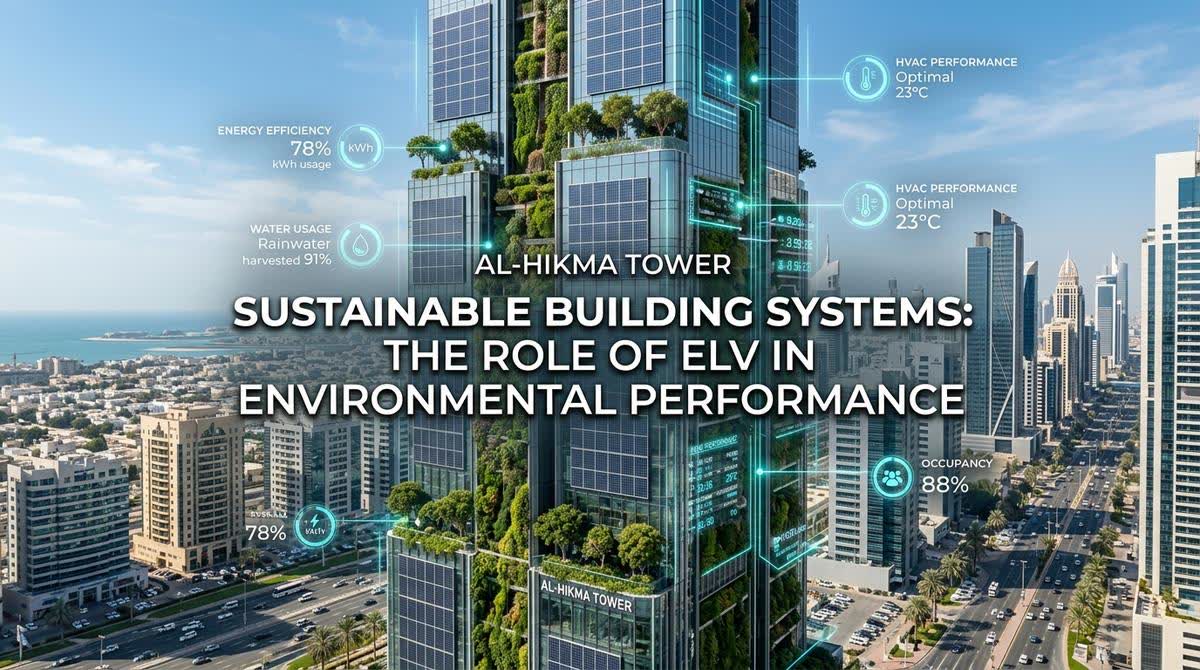
Sustainable Building Systems: The Role of ELV in Environmental Performance
Sustainability has moved from a peripheral concern to a strategic imperative in the built environment, driven by regulatory requirements, market expectations, and the genuine business benefits of reduced resource consumption and operational costs. For building owners, developers, and investors across the Middle East, understanding the role of ELV systems in achieving sustainability goals is essential for making informed investment decisions.
The region has embraced sustainability with remarkable ambition, with initiatives like the UAE's Net Zero by 2050 and Saudi Arabia's Vision 2030 placing environmental performance at the center of development strategy. Buildings, which account for approximately forty percent of global energy consumption and thirty percent of greenhouse gas emissions, are a primary focus of these sustainability efforts. The investment in sustainable building systems is not merely about regulatory compliance but about creating value through reduced operating costs, enhanced marketability, and long-term asset performance.
The Strategic Value of Sustainable Building Investment
The business case for sustainable building investment is compelling and continues to strengthen as regulatory requirements increase and market expectations evolve.
Regulatory Compliance and Risk Management
Regulatory requirements for building sustainability are increasing across the Middle East. The UAE's Estidama program, Saudi Arabia's Mostadam certification, and various municipal green building codes establish minimum environmental performance standards. Non-compliance can result in fines, delayed approvals, and reputational damage. Investment in sustainable building systems ensures compliance with current regulations and positions buildings for future regulatory evolution.
Operational Cost Reduction
Sustainable buildings consume less energy, water, and other resources than conventional buildings, resulting in significant operational cost savings. A 50,000 square meter office building with comprehensive sustainable systems typically achieves energy savings of 150,000 to 400,000 dollars annually compared to a conventionally designed building of similar size. Water conservation measures can save an additional 20,000 to 50,000 dollars annually. These savings directly impact the bottom line and improve property returns.
Enhanced Marketability and Premium Valuation
Sustainable buildings command premium rents and sales prices in the Middle East market. Tenants increasingly prefer properties with strong environmental credentials, reflecting both corporate sustainability commitments and the tangible benefits of lower utility costs and improved occupant comfort. Green building certification often correlates with rental premiums of ten to fifteen percent and occupancy rates that exceed conventional buildings. The investment in sustainability yields returns through enhanced marketability and premium positioning.
Occupant Health and Productivity
Sustainable buildings provide healthier indoor environments that support occupant health and productivity. Improved air quality, enhanced lighting, thermal comfort, and acoustic performance all contribute to well-being and performance. For office buildings, where labor costs typically account for eighty to ninety percent of operating costs, even modest improvements in productivity yield significant returns. The investment in occupant health is an investment in business performance.
Asset Value Protection and Appreciation
Sustainable buildings are better positioned for long-term value protection and appreciation. As regulatory requirements tighten and market expectations evolve, buildings with strong environmental credentials maintain their value while conventional buildings may face obsolescence. The investment in sustainability protects asset value and supports long-term appreciation.
The Role of ELV Systems in Building Sustainability
ELV systems are fundamental to achieving building sustainability, enabling the intelligence and control necessary for optimal environmental performance.
Building Management Systems
The BMS is the central intelligence of sustainable building operation. It monitors, controls, and optimizes building systems for efficiency and performance. The BMS coordinates HVAC operation to maintain comfort while minimizing energy consumption. It integrates with lighting control to optimize illumination based on occupancy and daylight availability. It monitors and manages energy consumption across all building systems, identifying opportunities for improvement. Without a properly designed and implemented BMS, sustainable building performance is impossible to achieve.
Lighting Control Systems
Lighting typically accounts for ten to fifteen percent of building energy consumption. Intelligent lighting control reduces consumption through strategies including daylight harvesting, occupancy-based lighting, schedule optimization, and task-tuning. A 50,000 square meter office building with comprehensive lighting control typically achieves energy savings of 50,000 to 100,000 dollars annually compared to conventional lighting operation. The investment in lighting control yields attractive returns.
Energy Monitoring and Power Quality Management
You cannot manage what you do not measure. Comprehensive energy monitoring provides visibility into consumption patterns, enabling identification of opportunities for improvement. Power quality management protects sensitive equipment and ensures efficient operation. Sub-metering enables allocation of energy costs to individual tenants, creating incentives for conservation. The data from energy monitoring supports continuous improvement and compliance reporting.
HVAC Optimization Systems
HVAC systems account for thirty to forty percent of building energy consumption. Optimization through ELV controls can reduce this consumption by twenty to thirty percent. Advanced control strategies include demand control ventilation based on CO2 monitoring, optimal start and stop based on occupancy prediction, economizer operation based on outside air conditions, and chilled water optimization based on load and weather. These strategies require sophisticated ELV systems to implement effectively.
Renewable Energy Integration
The integration of renewable energy sources into building operations requires sophisticated ELV controls. Solar PV systems must be monitored and managed for optimal output. Energy storage must be controlled for maximum benefit. Grid interaction must be managed to minimize costs and maximize value. ELV systems enable effective integration of renewables into building operations.
Water Management Systems
Water conservation is increasingly important in the water-stressed Middle East. ELV systems enable monitoring and control of water consumption, leak detection, and optimization of irrigation systems. Smart water management can reduce water consumption by twenty to thirty percent, representing significant savings in both utility costs and environmental impact.
Sustainability Certification Requirements
ELV systems are essential for achieving sustainability certification and the market benefits that certification provides.
LEED Certification
LEED (Leadership in Energy and Environmental Design) is the most widely recognized green building certification worldwide. Many ELV-related credits contribute to LEED certification. Energy optimization credits require comprehensive energy monitoring and management. Indoor environmental quality credits require monitoring of temperature, humidity, and CO2. Innovation credits can be achieved through advanced building systems. The investment in ELV systems supports LEED certification achievement.
Estidama Pearl Rating System
The Estidama Pearl Rating System is the UAE's sustainability framework for buildings. ELV systems contribute to Estidama certification across multiple categories. Energy efficiency requirements are supported by BMS and lighting control. Indoor environmental quality requirements are supported by monitoring systems. Management and monitoring capabilities are explicitly required for certification. ELV systems are essential for achieving Estidama certification in the UAE market.
Mostadam Certification
Saudi Arabia's Mostadam certification is increasingly important in the Kingdom's development market. ELV systems contribute to Mostadam certification through energy optimization, monitoring and verification, and indoor environmental quality. BMS capabilities are a prerequisite for certification. The investment in ELV systems supports Mostadam achievement and the market benefits that certification provides.
Other Certifications
Additional certifications including BREEAM, WELL, and Green Star also rely on ELV systems for achievement. The specific requirements vary, but all emphasize the importance of monitoring, control, and optimization capabilities. Understanding certification requirements is essential for system design and specification.
Investment Analysis for Sustainable Building Systems
The investment in sustainable building systems must be evaluated through a comprehensive financial framework.
Capital Cost Considerations
The incremental capital cost for sustainable building systems varies depending on the scope and ambition of the project. For a typical 50,000 square meter commercial building, the additional investment for comprehensive ELV-enabled sustainability systems ranges from 15 to 30 dollars per square meter. This includes BMS upgrades, enhanced lighting control, energy monitoring, and integration capabilities. The capital cost is typically two to five percent of total project cost.
Operating Cost Savings
The operating cost savings from sustainable building systems typically exceed the capital investment within three to five years. Annual energy savings of 150,000 to 400,000 dollars are achievable for a 50,000 square meter building. Water savings add an additional 20,000 to 50,000 dollars annually. Maintenance cost reduction through predictive capabilities adds further savings. The cumulative operating savings over a typical building lifespan significantly exceed the initial investment.
Market Benefits
The market benefits of sustainability investment are substantial. Rental premiums of ten to fifteen percent and higher occupancy rates contribute directly to property returns. Certification achievement enhances marketability and speeds leasing. Green building investment supports premium positioning in competitive markets. These benefits compound the financial returns from sustainability investment.
Risk Reduction
Sustainability investment reduces regulatory risk and positions buildings for future regulatory evolution. As carbon pricing and emissions regulations become more common, buildings with low carbon footprints will be better positioned. The investment in sustainability protects against future regulatory costs and asset obsolescence.
Total Cost of Ownership
When evaluated on a total cost of ownership basis, sustainable buildings consistently outperform conventional buildings. The combination of lower operating costs, premium rental income, reduced risk, and protected asset value results in superior financial performance over the building lifecycle. ELV systems are essential to achieving this performance.
Implementation Considerations for the Middle East
The implementation of sustainable building systems in the Middle East requires careful attention to regional characteristics.
Climate Considerations
The extreme climate of the region places significant demands on building systems and creates both challenges and opportunities for sustainability. Cooling energy consumption dominates building energy use, providing substantial opportunities for efficiency improvement. Solar energy resources are abundant, supporting on-site renewable generation. Water conservation is a priority in water-stressed locations. The climate context must be central to sustainability strategy.
Market Dynamics
The Middle East market is characterized by ambitious development projects and rapid growth. Sustainability is increasingly expected in premium developments and is becoming standard in commercial and residential projects. The market rewards early adopters of sustainable design and technology. Competitive positioning is enhanced through sustainability achievement.
Regulatory Environment
Regulatory requirements for building sustainability are increasing across the region. UAE and Saudi Arabia have established comprehensive sustainability frameworks. Other countries in the region are developing their own requirements. Understanding and anticipating regulatory evolution is essential for strategic investment decisions.
Technology Availability
The technology required for sustainable building systems is widely available in the Middle East market. Major manufacturers of ELV equipment and sustainability systems maintain regional presence. Qualified engineering and installation expertise is available. The supply chain supports sustainable building investment.
The AllandMuchMore Perspective
At AllandMuchMore, we understand the critical role of ELV systems in building sustainability. Our approach combines technical expertise with market understanding.
Strategic Assessment
We assess your building requirements, sustainability objectives, and investment parameters. We identify opportunities for improvement and develop recommendations grounded in business case analysis. Our assessment considers regulatory requirements, market expectations, and operational goals.
System Design
We design sustainable building systems that meet your specific requirements and achieve your sustainability objectives. Our designs reflect best practices and industry standards. We consider current performance and future evolution. Our designs are practical, cost-effective, and maintainable.
Quality Implementation
Our experienced teams deliver quality installation and commissioning. We ensure that all systems operate as designed and achieve the intended sustainability outcomes. Our testing and verification processes confirm performance.
Certification Support
We support certification achievement through documentation, performance verification, and compliance reporting. Our expertise helps you achieve LEED, Estidama, Mostadam, or other certifications efficiently.
In the End :
Sustainable building systems are essential for achieving environmental performance goals and maximizing asset value. ELV systems play a critical role in enabling sustainability through monitoring, control, and optimization capabilities. The investment in sustainable building systems yields returns through operating cost savings, enhanced marketability, risk reduction, and protected asset value.
Building owners, developers, and investors who embrace sustainability gain competitive advantage in the Middle East market. Their buildings attract quality tenants, command premium rents, and are positioned for long-term value appreciation. The investment in sustainability is not an expense but a value-creating opportunity.
At AllandMuchMore, we have the expertise to help you achieve your sustainability objectives through effective ELV system implementation. Our comprehensive approach covers everything from strategic planning through certification achievement. When you work with us, you are investing in sustainable building performance that delivers lasting value.