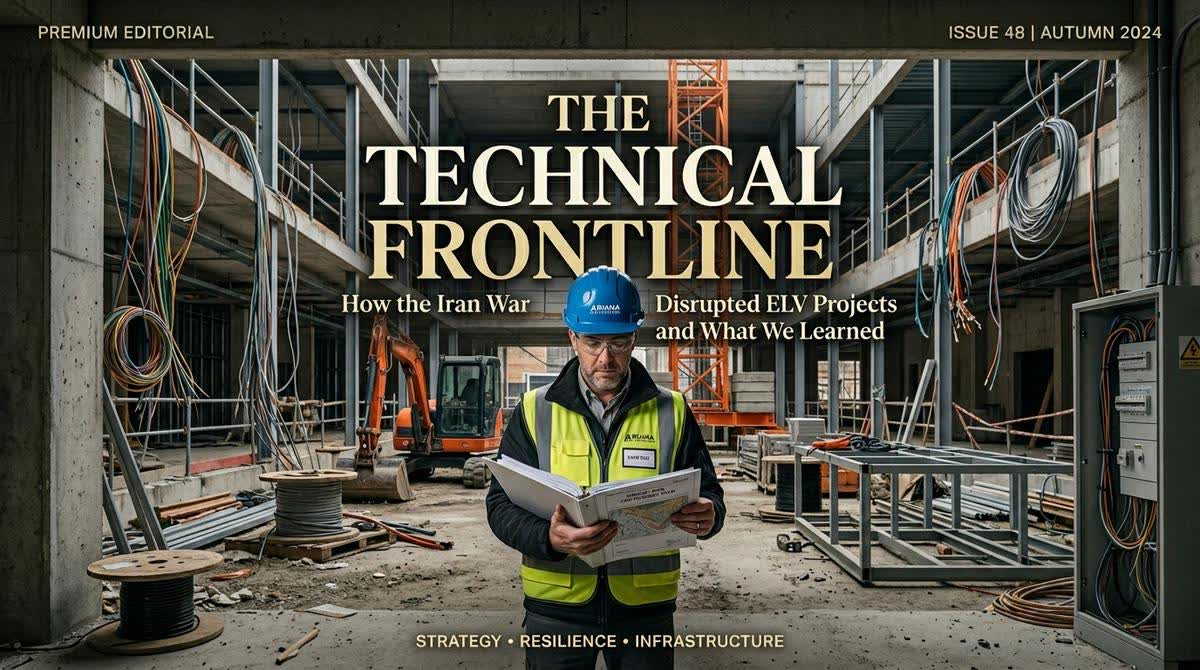
While the macroeconomic and strategic impacts of the Iran war have been widely discussed, the technical and operational challenges faced by ELV and infrastructure professionals on the ground have received less attention. Yet these challenges are where the war's impact was most immediately felt, and where the lessons for future resilience are most valuable.
This article examines the technical and operational disruptions caused by the conflict and provides practical guidance for navigating similar challenges in the future.
The Supply Chain Crisis: When Components Stop Arriving
The blockade of the Strait of Hormuz disrupted the flow of materials and equipment essential for infrastructure projects. For ELV professionals, this meant delays in receiving critical components.
The Impact:
Cable Deliveries Delayed: Specialty cables, particularly those with specific fire ratings or shielding requirements, faced extended lead times.
Equipment Backlogs: Network switches, servers, and other active equipment were delayed, forcing project teams to reschedule installation phases.
Price Increases: The cost of components that did arrive increased significantly due to higher shipping and insurance costs.
The Response:
Strategic Inventory: Companies that had maintained strategic inventory of critical components were better positioned to weather the disruption.
Supplier Diversification: Projects that had diversified their supply sources were less affected than those dependent on a single supplier or shipping route.
Phased Implementation: Project teams shifted to phased implementation approaches, prioritizing critical systems and deferring non-essential work.
The Labor Shortage: When Skilled Workers Leave
The war caused significant displacement of workers across the region. With 3.7 million jobs lost, many skilled workers left the region or were unable to travel to project sites.
The Impact:
Installation Delays: Projects faced delays in installation due to labor shortages.
Quality Concerns: With experienced workers unavailable, there was increased risk of installation quality issues.
Training Challenges: Training new workers on complex ELV systems became more difficult.
The Response:
Cross-Training: Project teams cross-trained available workers to cover multiple roles.
Remote Support: For some projects, remote support from engineers in other locations helped bridge the skills gap.
Enhanced Quality Control: With less experienced workers on site, quality control processes were intensified.
The Security Threat: When Sites Become Targets
The attacks on Jebel Ali port, Dubai International Airport, and other infrastructure highlighted the vulnerability of project sites.
The Impact:
Site Access Restrictions: Some project sites were in areas affected by military activity, restricting access.
Security Requirements: Enhanced security measures were required at project sites.
Insurance Challenges: Insurance coverage became more difficult to obtain and more expensive.
The Response:
Enhanced Site Security: Project sites implemented enhanced security measures, including access control, surveillance, and perimeter protection.
Remote Monitoring: Where possible, remote monitoring was used to reduce the need for on-site presence.
Risk Assessment: Projects conducted enhanced risk assessments and developed contingency plans for security incidents.
The Power Crisis: When Energy Becomes Unreliable
The energy shock affected power availability and reliability across the region. For ELV systems, which depend on reliable power, this was a significant challenge.
The Impact:
UPS Dependency: Uninterruptible Power Supply (UPS) systems were more critical than ever, with extended runtime requirements.
Generator Fuel Shortages: Diesel generators faced fuel shortages as supplies were disrupted.
Grid Instability: Power quality issues increased as grid operators struggled to manage supply and demand.
The Response:
UPS Capacity Upgrades: Projects upgraded UPS capacity and runtime to handle extended outages.
Fuel Storage: Additional fuel storage was implemented to ensure generator availability.
Power Monitoring: Enhanced power monitoring was implemented to detect and respond to quality issues.
The Communication Disruption: When Networks Go Down
The attacks on data centers and communications infrastructure disrupted network connectivity. For projects that depended on cloud-based collaboration tools and remote access, this was a significant challenge.
The Impact:
Remote Access Lost: Project teams lost access to cloud-based project management tools and design files.
Collaboration Disrupted: Communication between on-site and off-site team members was disrupted.
Data Access Delayed: Access to technical documentation and vendor support was delayed.
The Response:
Local Backup: Project teams implemented local backup of critical documents and designs.
Alternative Communication: Satellite phones and other alternative communication methods were deployed.
Decentralized Decision-Making: Project teams were empowered to make decisions locally when central approval was not possible.
Lessons for Future Resilience
The Iran war provided a harsh but valuable education in project resilience. Several lessons emerge for ELV and infrastructure professionals:
1. Diversify Supply Chains
Relying on a single supplier or shipping route is a significant risk. Projects should diversify supply sources and maintain strategic inventory of critical components.
2. Build Redundancy into Systems
Redundancy is not just about equipment; it is about processes, people, and communications. Projects should have backup plans for key functions.
3. Invest in Remote Capabilities
The ability to monitor and manage systems remotely is essential when on-site access is restricted. Projects should invest in remote monitoring and control capabilities.
4. Develop Local Capabilities
Relying on foreign expertise creates vulnerability. Projects should invest in developing local technical capabilities.
5. Plan for the Worst
Contingency planning is not a luxury; it is a necessity. Projects should develop comprehensive contingency plans for a range of scenarios.
6. Document Everything
When remote access is lost, documentation becomes essential. Projects should maintain comprehensive, locally accessible documentation.
7. Build Strong Relationships
In times of crisis, strong relationships with suppliers, clients, and partners are invaluable. Projects should invest in relationship building.
8. Embrace Flexibility
Rigid project plans are vulnerable to disruption. Projects should embrace flexibility and be prepared to adapt to changing circumstances.
The Path Forward
The Iran war was a seismic event that exposed vulnerabilities in the region's infrastructure and project delivery systems. But it also demonstrated the resilience of the professionals who work in this sector.
As the region moves into a reconstruction phase, the lessons learned from the conflict will be invaluable. Companies that apply these lessons will be better positioned to deliver successful projects in an uncertain environment.
At AllandMuchMore, we have integrated these lessons into our project delivery approach. We have strengthened our supply chain resilience, enhanced our remote capabilities, and developed more comprehensive contingency plans. We are committed to being the partner our clients can rely on, even in the most challenging circumstances.
In the End : A New Era of Resilience
The Iran war of 2026 marked a turning point for business and infrastructure in the Middle East. The economic devastation, the disruption to technology and infrastructure projects, the vulnerability of digital infrastructure, and the massive reconstruction effort have fundamentally reshaped the region's business landscape.
For companies operating in the region, the lessons are clear: resilience is not optional, it is essential. Diversified supply chains, redundant systems, remote capabilities, and comprehensive contingency planning are no longer best practices, they are requirements.
The reconstruction effort presents significant opportunities for companies with the capability to deliver. The $300 billion fund created by the US-Iran framework agreement, combined with national reconstruction efforts, will create decades of work in infrastructure, technology, and energy.
But the challenges remain. The geopolitical environment is uncertain. Energy prices are volatile. Supply chains are fragile. The companies that succeed in this new environment will be those that combine technical excellence with strategic resilience.
At AllandMuchMore, we are committed to being that partner for our clients. We have the technical expertise, the project delivery capability, and the resilience to succeed in even the most challenging circumstances. We are ready for the future, whatever it may bring.